Wednesday, June 20, 2012

Real Artists Experiment


Often times, when you're looking at the work of any "big name" commercial artist, you'll see a very distinct style.  Sometimes it'll change a bit from solo show to solo show for any given artist, but most likely what you see on their blog and in their portfolio is a very cohesive body of work.

This often leads us to believe that these people don't experiment.  We think that maybe these artists "have found their style" and don't deviate much from it and just keep making paintings all in the same style over and over again.

However, part of this is the game they have to play as commercial artists.  As a high-profile artist, often times there is a lot of pressure to stick to a certain style as galleries are businesses, first and foremost, and if the artist got big doing a certain style, they're going to want what is already proven to sell.  Often times the artist will recognize this and continue to make art in that style to appease the gallery and their fans, as this is what allows them to live off their art.

That said, we only usually get to see what they do in the public sphere.  Just because we see our favorite artists doing the same thing over and over again doesn't mean that they aren't trying out new mediums, or new styles, or new subject matter.  We just don't get to see it.

So go out there and experiment.  Try something new.  If you paint, what about some sculpture?  If you do installations, what about some pen and ink drawings?  Create photo-realistic stuff, try some doodling.  Manga artists, how about some landscape paintings?  However outside of your comfort zone you're willing to go, we say "Go there!"  

Just as the public doesn't get to see a lot of artists' experimental work, the public doesn't necessarily need to see YOUR experimental work.  Under no obligation must you post it on a blog, or put a photo on Facebook, or do you need to show another living person if you don't want to.  Go crazy, and if you hate it, dump it, burn it, whatever.  The main thing is that by pushing yourself to go someplace that you haven't gone before, it'll change the way you look at what you "normally" do.  You might gain some new insight, or you might even find something you really enjoy (maybe even more than what you usually do).   This experimentation, while it may be your "new style" in the end, is really for you and your artistic soul more than for anything else, so try something new when you get the chance.


Wednesday, June 6, 2012

How to Save Yourself From Burn Out


When I arrived Saturday morning for my weekend painting workshop, I was tired from the week's work - month's work, to be precise. I had taken on one too many calls, one too many emails, one too many art-donation charity events, one too many project, and not taking good care of myself. I was "burnt-out." This is the dark side of the artist life.

When we are depleted of time and energy, so it our creativity and art. We become a snarling animal prodded one too many times and we refuse to perform any more magic acts. Having experienced burnt out before, I thought I knew how to avoid it. I thought I knew better. But it's difficult. The fine line between a fun creative productive artist and a manic overworked "horse" is very thin. Although sometimes there doesn't seem to be much of choice between work/rent vs sustainability/rest, we have to remember - there is always always a choice.

Contrary to the myth that artists are selfish, I think we are very generous - perhaps even too much. We are often taking on projects that are not ours. We make posters for Uncle Steve's bbqs or little Billy's birthday party for no cost. We often volunteer in some creative or mentoring program for the community. People often use artists as a sounding board for idea pitches, solicit critiques, or even rants on personal lives without refilling our energy wells. We, ourselves, often dip into our own well and drain it faster than we can refill it. We say "yes" to the latest social gathering when we really want to be alone with our art. Or quite the opposite, we stay home, when we really want to go dancing but are afraid. In short, we are NICE PEOPLE, but not necessarily honest to ourselves.

But what if I have kids or are in a relationship or have friends who need me? You ask. Surely, they come first before my art? The truth is: we can become better family members and friends when we take care of ourselves and our needs first. When you give to yourself, your energy and time will surprisingly multiply by ten fold.

It's time to think a little bit more of ourselves. It's time to be more selfish. Take care of your artist self. Invest in yourself. "Stop being nice, and start being honest," as writer Julia Cameron said. So you don't want to do this project, DON'T DO IT. Give it to someone else who has the time and is more passionate about it. So you need to stay in instead of a movie date? Take a raincheck. But what about timed events that you have to attend, but may not have energy for, like gallery openings, friend's poetry reading, or billy's birthday party that might make or break your friendship or relationship? Well, take care of yourself days ahead and the morning beforehand, so you have plenty of rest. Wake up earlier in the week before work, or sleep in, or find the time and prioritize your creativity so that at Billy's birthday party or your friend's poetry reading, you are alert, attentive, and present - NOT thinking about your novel or project back home and seething at Billy in resentment.

Self care and freedom is the best remedy for burn out. A little goes a long way. Like buying your favorite soap for $2.99 or warm hot cocoa. Finally watching that movie or reading that book that you've been putting off. Calling a friend who can help you refill the well by listening to you. Freedom from email or phone after dinner. Freedom to rest. Freedom to see friends or go on a run. Undisturbed guilt-free time. It's going to be different for everyone.

At the weekend painting workshop, my teacher Erik Tiemens always seemed very energetic, creative, and animated.

"Attack the paper," he would say.

"Play with the paint, without having an end-product in mind." I don't know if this is true, but I suspect that he will always be young-at-heart and creative because he gives himself the freedom to play.

Our artist self is like a seven year old kid. If we told it to sit still, be quiet, and do your work for one too many times, it will start to rebel. So we need to communicate to them that we'll listen to them. That we will give them a treat for being so good all this time. That we are on their side and it's safe to create again.

Just ask yourself, what do I want? If there are no emergencies, no restrictions, deadlines, or people depending on me and I have the freedom to do whatever, what do I want?


Wednesday, May 30, 2012

The Balance Between Business and Art

Monkey reads a lot of marketing and business blogs, courses, and books.  He makes sure he has a strong grasp on the business side of Monkey + Seal, as he handles a majority of those aspects.  However, while educating yourself about the business side of art is helpful and necessary for most, many artists have trouble managing the balance between the business development side of art, and the actual creating.

When Seal is working on a freelance project, she usually hits a 70% creating - 30% business, which is super awesome.  Monkey, on the other hand, is lucky to hit 50-50.  So how do you manage your own creation-business balance and what is the ideal?


While if you're already familiar with the business side: marketing, budgeting, pricing, distribution, accounting, and maybe stuff like web designing or printing, you may struggle to find more time to devote to your creating.  However, if you're already making art like a fiend but have no idea how to do any of that business stuff, perhaps you need to spend more time developing your business skills.

So what's the ideal ratio?  Well, it all depends on you.  Personally, a good balance with a stronger emphasis on the creating is what we recommend.  For us, we'd rather be at 90-100% creating, and doing very little business stuff (maybe we should hire an agent or assistant), but there are definitely people out there who really enjoy some of the business part, so you should lean more towards the business side.

The reality of it is that an ideal is probably about 70-30 creating-business.  Seal has found that works well for her, and Monkey agrees.  Monkey has been struggling with this personally for some time, usually spending closer to 80% of his time on business, sadly skimping on the creating.

If you make this same mistake, what happens is that while you may be great at drawing an audience and making sales, what you soon find out is that you run out of stuff to promote or develop.  Monkey lost focus on what was really important (making art), and focused too much on the "gotta make money" side of things.  He recently shifted more towards 50% creating (a big swing for him), and he found that by doing more of what he loves (creating), the money (the business) is following.

So we encourage you to spend more time doing what you love and less time doing what you don't like to do.  While learning the basics of marketing and selling art is important if you want to make a living off of it, make sure that you don't forget what your main purpose is: creation.  Do more of what you love, and the money will follow.  

Wednesday, May 23, 2012

Thousands of Dollars Worth of Lessons From Spectrum Fantastic Arts Live!


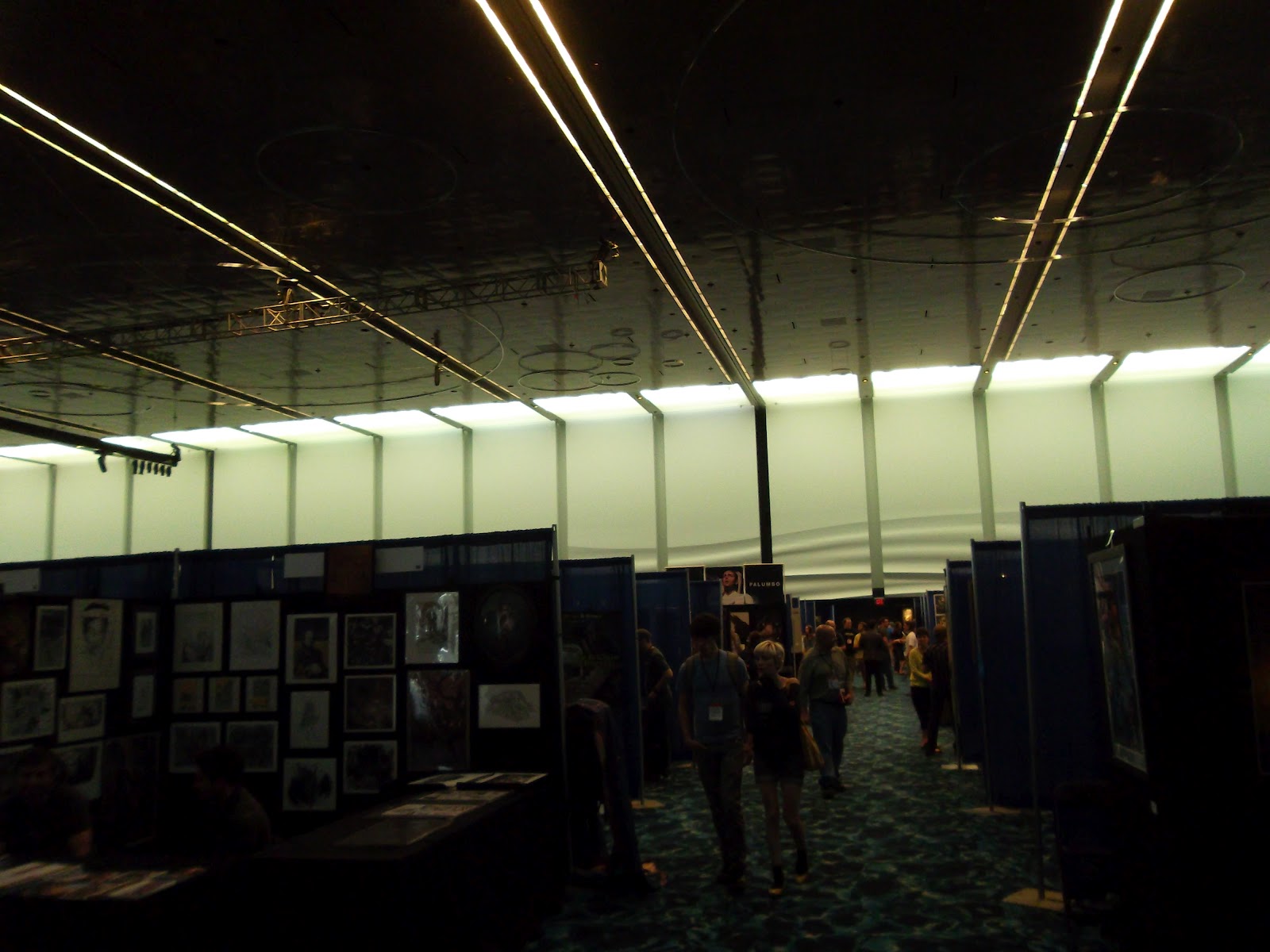
This past weekend Monkey + Seal took the long trip over to Kansas City for Spectrum Fantastic Art Live!  It was three days of being surrounded by some of the most amazing contemporary fantasy artists out there. 

The week prior was sort of a whirlwind of madness.  Seal had concept art, storyboard, and commission work to do.  Monkey had an event he was coordinating on Wednesday, then hung the latest Big Umbrella Studios show on Thursday for the opening on Friday, and he painted all weekend.  Then, it was a mad dash Monday through Wednesday to finalize transportation plans, get prints made, figure out new displays, and pack. 

Monkey ordered plastic sleeves that didn't come in on time, we didn't sleep from 1:30pm on Wednesday until we got on our plane at 2:30pm on Thursday.  There were no restaurants open by the time we rolled into our hotel at 1am Friday morning, and so we had a large amount of pretzels, snack crackers, and dried fruit for dinner.

When we arrived at the convention center the next day, Monkey started freaking out due to the sheer overwhelming amount of "big name" artists with huge original paintings and giant, framed canvas prints.  However, Seal's courage was strong enough for the both of us and as Monkey calmed down, we started to set our booth up.


Over the next three days, we got to meet some amazing artists, listen to great presentations, and we even managed to sell some merchandise.  Even though the crowd was much smaller than we had hoped, we learned a lot and came out smiling.

To be honest, it was an expensive bunch of lessons and tips (even trying to take all the budget options) we ended up investing thousands of dollars that weren't made back.  This was a bit hard to take in, but the lessons were invaluable and viewing this as an investment in our careers rather than losing money has helped ease the sticker shock considerably.
 
Rows and rows of awesome artists and art

 Some good take-aways we learned:
-It's painful and scary to be beginners.  However, what option did we have?  Pack up and quit and go home?  Nay, you just gotta do the best with what you have.  Everyone has to start somewhere.

-From Mike Mignola: If you never put out that dream project, you'll never have the chance for movie rights and other "big time" offers.  Expect to make no money and do it for the love of it, and who knows where it will go.  At least you've put it out on paper and sent it out into the world.

-When you're just starting out in fantasy illustration, 5-6 amazing pieces is all you need in your portfolio.  Take out all the filler, emphasize the "amazing" part.  Also, tailor it specifically to the company you are submitting it to.  Your portfolio for Magic:the Gathering is much different than your portfolio for book cover illustrations, which is much different that the portfolio you submit for editorial work.  

-from basically every presenter: DO WHAT YOU LOVE

-From Donato Giancola: Expect to make absolutely no sales from any craft fair/exhibition/expo, and just go for the love of it.  Think of it as investing in your career.  You'll always leave happy.

-We figured out that we have to step up our own game - we're working on designs for new display units as we type!

-Established artists are sometimes insecure and freaked out as well!  We've overheard numerous other exhibitors freaking out over who they're vending with as well.  One artist on a panel (who freelances full-time for Wizards of the Coast + others) said "I still feel like someone is going to reveal me as a fraud."  Sound familiar?
Overall we had a great time, got to (re)meet some other Bay Area illustrators and meet some of our heroes.  We have no regrets and are super thankful we were able to take the plunge and make it out to a whole new venue and a whole new level!

Award Ceremony honoring artists who won the Spectrum Silver and Gold Award
James Gurney receiving the Grand Master: an artist who has had at least 20 years in the art industry, who inspires others, and has made an impact in the community. He is Seal's hero.
Onwards! Towards more adventures!


Wednesday, May 16, 2012

Fear or Love? Your Choice


"If you try and give it your best shot, then the possibility isn't zero"

This weekend, Monkey and Seal will be on a plane towards Kansas City, Missouri for Spectrum Fantastic Art Live. We'll be vending next to some of our long-time art heroes. It's quite scary to be honest. We have never been to Kansas City. This will be our first out-of-state show. Most of the artists we'll be vending next to have at least 10-50 years of professional experience and have been published worldwide. Some of them have been doing art long before we were even born.They made the art that we looked up to as children. For Monkey, there is an artist that he has been following since he was 11 years old. We have also submitted multiple annual competitions for Spectrum, the magazine that is hosting the event, but have yet to break in and secure a published page. So going in there, we're pretty much unheard of. We are babies.

When we signed up, we didn't know what we were getting ourselves into. We thought it was going to showcase more different levels of experience, but everyone so far seems to be well established professionals. So in the last couple of days, as reality creeps on us, there is an overwhelming impulse to run away. To say, we're not ready for this. Maybe next time.

But we have this sign that we made, posted in our humble apartment when we first moved in about six years ago, "What would you do if you weren't afraid?"

So we asked ourselves, what is the worse that can happen? We don't sell a damn thing and don't make our flight money/hotel//booth back, but we can meet our heroes, geek out over artwork and life-changing workshops. Go or not go, which choice can we live with later with no regrets?

I think everyday, there is an opportunity to say yes to either fear or love. Fear of failure. Fear of embarrassment. Fear of the unknown. Fear that the journey is long and your skill level is not where you'd like it to be. We can choose those things. But we can also choose love. Love of art. Love of accomplishment. Love of pursuing something rewarding. Love of your work to have pride for it regardless of what people think of it. Love of people, artists. To recognize and acknowledge each other as unique creators. Love of the mysterious unknown. Love of the awkward growing pains. Love of yourself and how far you have personally come from.

In life we are always either running away or running towards our dreams. Why not choose the path that promises a brighter ending? After all, if you try and give it your best shot, then the possibility isn't zero. You're opening a window. You can make "impossible things, " possible, if you take a step forward.

So what can you do today to make that step towards your dream?  What are you scared of that you can embrace?  What path will you choose today that will promise a brighter future?  Grab hold, and let's take a step forward together.


Wednesday, May 9, 2012

Don't Fear Revisions!

I need to revise some fables...

Most artists' stance on revisions of their work are polar opposites: either you love them or you hate them.  For those that love to revise your work, awesome.  For everyone else, read on.

Today we wanted to talk about revising your work.  While this is a day-to-day part of the business for illustrators and designers who are hired to execute specific images and are often asked to revise images repeatedly, we wanted to talk about self-initiated revisions.

For many of us, revising isn't easy. Usually it's because of one of three reasons.  Either we're in love with the image, we don't know what to fix, or we're tried/frustrated/over it.  

When you're working on a piece of art, you'll come to love a certain part of the image, if not the entire thing.  Maybe in a figure painting you really did an awesome job on the hands, or the ear, or the hair.  Maybe in a script you have a piece of dialogue that you absolutely love.  However, as William Faulkner has said, "Kill your darlings."  

While Faulkner said this to imply that any piece of writing that stands out as too-amazing probably isn't right for the story, we'd like to suggest that it means that you have to be willing to revise parts of your work that you like.  After all, would you rather have a painting of a person with a really awesome ear, or would you rather have a really awesome painting of a person?  

It's really difficult to do, and especially affects beginning artists.  This is because when we're just starting out, we tend to highly value our paintings, especially our best ones.  We think "This is my best painting yet!" and don't want to touch it for fear of messing it up. However, we have to keep in mind that we will create more and more pieces of art, and we should strive for always making each piece better than the last.  (although not if you're experimenting - then you should just experiment and have fun).   The best way to get over this is mileage.  Unfortunately, it may be tough to just start killing your darlings right away, but after you've put in hours and hours and created work after work, each piece becomes less and less important as a whole since you start to learn that you're always improving, and that your "best piece" is always yet to come.  If you keep your old work and compare it to your newer work, you should see some growth (unless you're not putting in the work and time), and this is a great way to remind you to not fear revision.

The second reason why revisions might give us difficulty is that we just don't know what to fix.  Especially when you're starting out, figuring out what exactly is wrong can be a huge challenge in itself.  During our stint at art school, we were told by one of our drawing teachers that the only difference between a student and a professional is that the professional knows what they need to fix, while the student doesn't.  While this isn't always true, the sentiment is.  Basically, if you don't know what to fix, how can you fix it?  

Really, the only way to combat this is to continually study art.  Whether that means art school, or taking classes, or working with a group of other artists, or carefully examining other pieces of art, it's all about expanding what you know so you can see what you need to work on in your own work.  Most of the time, the problems will be habitual, so it may take a while to see exactly what isn't working, but if you take a step away from your work and return to it, the issues usually become more obvious.  Go go revisions, go!

The third reason why artists skimp on the revising is what people might call "laziness."  We don't think that is really true - it's not laziness, but a general frustration with the piece.  Perhaps you waited to start a piece too late and it's due for a critique or even a gallery show.  Maybe the client is demanding and frustrating and visually clueless.  Perhaps you took a job that doesn't pay you your worth.  It could be that you just don't know how to fix the problem or haven't developed the skill yet.  Regardless, when people tend to go "the lazy route" and not to revise/fix things that they know are problematic, it's usually due to a larger emotional issue than just plain "laziness."

This is the most dangerous form of fighting revision, mainly because it involves actively making the choice to ignore an issue, which leads to your standard of work dropping.  This can lead to a reputation for poor work, current clients dropping you, etc. etc., all stuff that isn't too good.  

So how do you fight this form of revision anxiety?  We've found that the best way to to give yourself some time.  Procrastination is one of your biggest enemies, with Taking-On-Too-Much being a close second.  The more time you give yourself to work on your project, the better off you'll be, and the better state of mind you'll be in to make needed revisions.  

A good basis to start budgeting more time is to figure out how much time you think a project will take you, and then double it.  Think you'll knock out that painting in three days?  Give yourself six.  Think of it as a "distraction/emergency allowance."  Need a nap?  Take it.  Get sucked into the internet?  That's what all that extra time is for.  Have a freelance project that is a rush job?  Now you can take it!  Optionally, sometimes it just takes you a lot longer to create something than you originally thought, and with the extra time, you'll be in much better shape.  Heck, if you finish in the time you originally thought it would take you, then now you have more free time (or time for personal pieces, walking the dog, doing laundry, whatever).

Even better yet, if you budget in time for revisions, you'll be a happier camper-artist.  We usually find that if we give ourselves 6-8 hours away from a painting, upon returning to it, we'll immediately see things we missed in our first pass and be able to quickly fix them.  If we try to do a huge marathon paint  session, usually we'll miss things since after you stare at something long enough, it all looks right (or it all looks wrong), and by stepping away you allow yourself a fresh perspective.  

So revising is your friend.  It's how you get better, it's how you learn new things, and is how you grow as an artist. We know that there might be a lot of reasons why you prefer not to revise, but if you really want to take your work to the next level, learning to embrace the revision/editing process will make your  transition faster.  

Tuesday, May 8, 2012

The $100 Startup

So for all you out there who are interested in starting up a business (art businesses count!), we wanted to share with you a new book that came out today called "The $100 Startup."

If you're not looking into taking hold of your life by the horns and working for yourself (like we always say, entrepreneurship is not for everyone), please feel free to just skip this and come back tomorrow for our usual art posts.

If you are interested in working for yourself, either as an freelance illustrator, or maybe a photographer, or any type of business where you are your own boss, definitely stick around and hear us out on this.


"The $100 Startup" is not the book for people who are content to sit around and think about their dreams, but is for people who are actively looking to get up and do something about it.  If you're long-time readers of the blog, you know that it's all about hustle-hustle-hustle, and the book has a whole chapter (Chapter 9) on hustling, or as Chris defines it: "building interest and attracting attention."

Filled with case studies of others entrepreneurs who all make at least $50k a year from their small businesses, this book gives you the blueprint to start your own little company based on something you love.  The first part of the book examines the lean and mean $100 startup business model, and also leads you through how and why you might want to start up your own (side) business.

The second part of the book talks about the basics behind launching a product, marketing, getting your stuff out there, unconventional fundraising, and one-page business plans.  Lots of good stuff here to get you up and running.

The third section of the book is about expanding (or choosing not to), leveraging your existing resources, and talks about what to think about for the long haul.  Throughout all the sections, Chris intersperses advice with the case studies I mentioned earlier.  

While I wish there was a bit more specific advice and less storytelling, I do realize that specific advice for me doesn't apply to everyone, and vice versa.  Chris did the best job of straddling that fine line between sharing what worked for others and what might work for you.  Also, as someone who has read a lot of online marketing material and bought courses, this book didn't offer many mid-tier/higher level advice, but then again, that's not who this is for. 

This book is for people who haven't taken that first step towards becoming entrepreneurs, and want to learn more about the process before they dive right in.  I think this would also be great for any college-age students who are getting a bit disenchanted with the job market out there right now.

Overall it's a lot of information Chris has shared in his premium Empire-Building-Kit, but if you want a distilled, no-frills version of his $149+ premium course for a budget price, this book is the way to go.

Head on over to read more about Chris or to buy the book or to buy any of his other hand guides here.  


Full disclosure: we got a free copy of this book from Chris, and we're also part of his affiliate program, but that's only because his stuff is really good and Monkey has bought almost all of his products.