Showing posts with label life stories. Show all posts

Thursday, February 14, 2013

When someone believes in you . . . (Part I)


As a junior in high school, I knew I wanted to be an artist. I gathered my random drawings and doodles and applied to Art Center College of Design. I received a four-semester full tuition at their illustration department. During the rest of my high school years, my mother was diagnosed with cancer, my father was laid off from his office job due to work politics, and my sister developed manic depression. So when I finished senior year and couldn’t afford to continue at Art Center, I took on two jobs and schooled myself through city college while helping to pay the bills at home. The first semester of junior college, I took painting, acting, and dance classes. To this day, that was one of the most memorable years. As I immersed myself at my jobs and academics, I slowly lost track of my direction. My parents, though well-meaning in their quest for our family’s survival, told me to “stop dreaming,” that “art was just a hobby,” and “it won’t pay the bills.” They told me that even if an artist were even able to “make it,” it would be because they started out already really, really good, that they had talent and had wanted it since at a very young age. Since I didn’t express my interest in art until high school, I believed them: I believed that whatever passion I had for art, was not enough to begin with. I didn’t show an overwhelming promise. I didn’t start early enough, I thought. They took me aside and looked at me with pleading eyes, “You don’t really want to go into art now, do you?” I was confused. I nodded. I would forever regret my own collusion and betrayal.


I doubled my focus on work and academics and found that I loved Literature. In my last year of English class at city college, my teacher Ms. Allison Murray assigned the class to write personal essays based on the UC school application themes. It was a required final essay to pass the class. I turned mine in, not expecting much. “You should actually apply to the UC with this essay, “ she confronted me in the hallway. I thought of my entire extended family, most of who never finished beyond junior high. I thought of my mother who finished her masters in engineering, whose degree wasn’t recognized in the US, who worked at Gatorade bottling juice and vacuumed offices as a janitor, and my Dad who would glue little tabs unto A frames so when people had displays at stores, these A frames would stand properly. At that time, I worked two jobs and didn’t even pass the ESL test even though I grew up in the US, there was no way a four-year college was possible for me. For the next two weeks, Ms. Murray pestered me, emailed me, called me, “Did you turn in your essay and application to the UC?” The answer was always the same, “I’ll think about it.” Seeing my mother worried about bills at night by the kitchen light, my father pulling double work shifts, and my sister struggling through her own school, I didn’t think I had a right to apply.

I prepared myself to disappoint Ms.Murray by telling her I wasn’t going to apply after all. After class, I took my time to leave, hoping to talk to her alone. She said goodbye to the students leaving and our gaze met, her eyes narrowed, her voice quieted and slowed with intensity she said, “You.Can.Do.This.”

I thought about why it was I was drawn to art and literature in the first place and even though it was hard to pursue, why I wanted to continue: I wanted to find the key to myself and I wanted to express myself through art and writing. I also wanted to encourage others to climb their own mountains and grab a hold of their own individual keys. I turned in my essay to the UC system. In the spring, I was accepted to all of the five schools I applied for: Berkeley, UCLA, Irvine, Santa Cruz, and San Diego.

When someone believes in you, it is the greatest selfless love that one can give.

Has someone believed in you and made a lasting impact on your life? Be sure to thank them and let them know how you’re doing!

I have many people to thank in my creative and self-discovery journey (Rick, Martha, Carlos to name a few) and they all deserve their own post and recognition.  So please stayed tuned for Part II of “When Someone Believes in You . . . “

Wednesday, February 6, 2013

Creating Good Habits


Sometimes people have things that cause them to do the same thing over and over again.  Invisible scripts.  Inherent trait X.  Habits.   Whatever you want to call it, we all have them, both good or bad.  Sometimes our bad habits get in the way of being awesome, and you may stop and think "Ugh, I wish I didn't always do X."  Whether "X" is spending too much time reading celebrity gossip, or constantly checking your email instead of working, how do we break them?

First off, we have to understand why are habits so hard to break.  Habits are really neurological pathways that have been reinforced over years and years of doing them.  It's no wonder that they come so naturally to us.  They are literally wired inside our brains.  In fact, the lame part is that once we have a habit, the pathway in our brain never goes away.  So the downside is that if you have a habit of always criticizing your art as soon as you're done with it, no matter how much work you do to change that, it'll always be there, no matter what.

However, there is good news.  We can create new, positive habits that will reinforce what you want to do.  Besides, making things habitual is easier in the long run, than constantly fighting your current bad habits.

How to create positive habits?  It's about designing systems that allow you to create the habits you want through a reward system.  We need as much help as we can get when trying to replace old habits with new ones, so by creating an outside system that will encourage you to follow through.  

Want to wake up earlier?  Have an early-bird friend call you every morning to hold you accountable.  Give that friend $60 at the start of a month, and every time you don't answer your phone, they get to keep $2.  Buy your favorite breakfast food (whatever you want, whether that's Lucky Charms or creme brulee), but you only get to eat it if you wake up early.  Basically, the more reward/punishment systems you can set up to hold yourself accountable, the better. The good news is that rewarding good behaviors works faster than punishing not following through.  So make sure to get that extra box of pop tarts.

Additionally, when you do reward yourself, make sure that you enjoy the reward, guilt-free.  If you are rewarding yourself with time allotted for video games, then don't play the games and think about how you "should" be working.  Just play the games for that set amount of time and have fun.  Just like if you're rewarding yourself with cookies, don't mourn the amount of butter in the cookies, just enjoy the cookies!

To help out anyone wanting to change a habit, we'll even offer to help you out.  Email us (info [at] monkeyandseal.com) with your name, email, and habit that you want to create, and we'll email you once a day for a week to offer words of encouragement and check in with you.  You can do it!  Start building a good habit today!

Wednesday, January 9, 2013

Building a Strong Foundation (In Life)


Before you decorate the roof, you must first build the foundations of the house deep into the ground.

In filmmaking, we call this “finding the broad stroke.” A couple of months ago, I sat at a film story-brainstorming meeting. We were all very excited about a new story we were working on. We had the details down to the characters’ colors, the time of day in which the story takes place, and we were chattering up a storm when one of the soft-spoken writers raised his hand, “But what is this film really about? In one sentence what is the backbone to the story?”

Now I ask you, what is the backbone to your dreams? Sure you can decorate your dreams with shingles, pretty flowers on the front porch, and a tire swing in the backyard, but what is it build upon? What is driving you? What is the reason?

Since I was in high school, I had dreams of being an art director. I didn’t know why I wanted to become one, just that I did and I worked really hard towards that trajectory. At age 19, I was given creative directorial duties at the community college theater program. At age 20, I was promoted at my work at Walt Disney into a supervisory creative role. At age 22-25, I directed plays at UC Berkeley. I am now currently working on two films as an art director. I had many chances at the role in the past and I messed up quite a bit in some of them. Because even when I had the title at an early age, I didn’t have a strong foundation to build my dreams upon. Growing up in a highly critical house being the shadow of my artistic older sister, I was constantly riddled with self-doubt, self-sabotage, and lack of belief in my own inner potential. I had no foundation. I may have looked like an accomplished decorated titled house on the outside, but the inside was bare bones.

It was as if I peered into the hood of a car and realized there was no engine. Perhaps the car had moved on its own because it was on a hill and gravity pulled it down into the valley at top speed. But when I found myself at the bottom of the pit, what drove my car, my dreams, up against the mountain?

It doesn’t take science to know that if you are empty or wounded on the inside, you cannot give much towards your dreams.

So how do you build the foundation for your dreams? It will differ from person to person. But first you must find the reason behind your dream. Then you must heal yourself from any physical, emotional, or mental splinters you might have had, so the trunks and roots of your dreams can grow deep into the ground. For a prominent blogger and millionaire business venture artist James Altucher, his physical and mental foundations are what were most important for him. If he is tired, and didn’t get enough sleep, or didn’t eat enough nutritional meals, he has a hard time focusing on his writing. So he makes sleep, exercise, and meals a priority. For Seal, her foundation is taking care of the physical body (yoga/jogging), meditation to quiet her inner critics (simple 5-10 minutes quiet time after she wakes up to know what to focus on during the day), as well as filling her creative life with daily adventures (visiting a bookstore, etc). When she sees new sights or experiences a new technique to approach her painting, the natural high can help her push pass the funk and challenges of going after her dreams. Her other foundation pillars also include integrity (she can’t take on a job if it goes against her values), community building (she wants other people to reach their dreams too, and she knows there are people she can count on when she’s down), optimism (you don’t know what’s going to happen within the next second, so why not hope for the best possible outcome?), and last but not least, her reason. At the heart of her dreams of being an artist, is the simple wish to share and be heard. To feel connected to other people through her art and her inner world. That’s it. Not as hard to accomplish and focus on her dreams when it’s narrowed down to a simple wish of living among other people and being understood.

What is your dream? What are your foundations to build upon?

Thursday, January 3, 2013

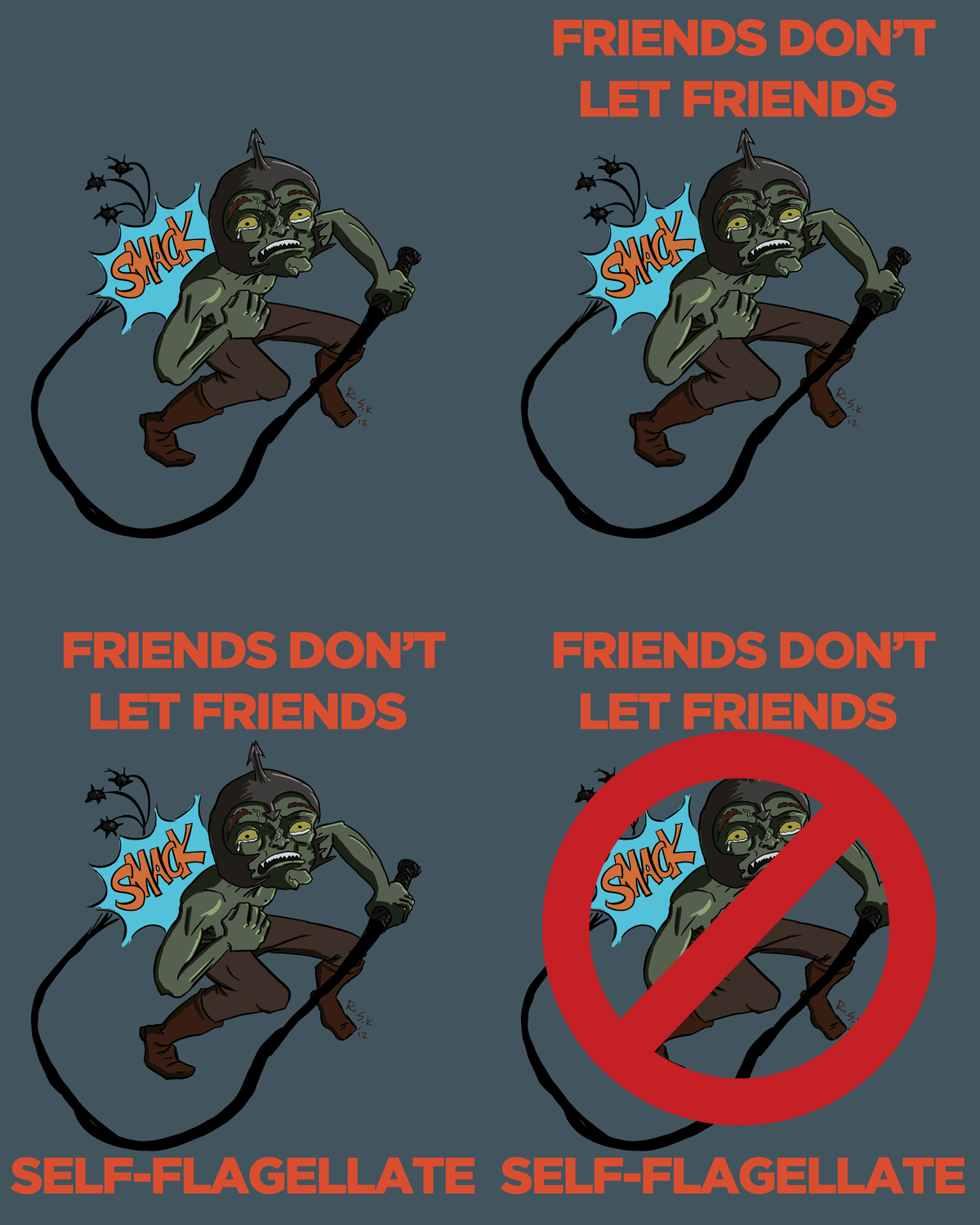
How Self-Improvement Will Destroy You

A very non-serious .gif by Monkey for a serious post by Seal. What a silly Monkey.

When I was seven years old, I started my first to-do list. I was quite simple, with only three items I wanted to accomplish every day.

  • Put away my toys
  • Make up my bed
  • Help parents clean the apartment

Ten years later, when I was seventeen, the list grew to more than a 100 items. It was no longer a daily list, but a resolution for life. I titled it “Goals in Life”. It included travel destinations, languages to learn, running record times to break, things to become . . .

  • Travel to Nepal, Africa, France, London
  • Learn French, Spanish, Mandarin, Japanese
  • Run 6 minute mile
  • Run 20 minute 3 mile (standard xcountry race)
  • Draw in 20 sketchbooks (I gave myself 6 years)
  • Read all of Shakespeare
  • All Greek Mythology
  • Collect stamps
  • Wrtie a novel
  • Make a film
  • Learn how to brew my own beer
  • Learn how to make my own cheese

The list went on, page after page. If you can’t tell, I was a very serious person who wanted to accomplish very big things. But at the heart of this list, there was something terribly wrong.

Although I read all of Shakespeare’s work in both junior college and in Berkeley, I couldn’t really use my knowledge of Old English and Literature in my everyday conversations. I hated Greek Mythology. I started a stamp collection, but I don’t even like collecting stamps. I managed to learn conversational Japanese and French on my own, but I have a high resistance to learning tonal languages such as mandarin. I don’t seem to have an ear for it. My friends make better beer and cheese that I did, so why not bum some off of them instead? And as I ran everyday and got close to breaking into 7-minute mile, I suffered an injury that put me out most of the x-country season during my senior year. I never did break that 6-minute mile or 20 minute 3 mile. And although I accomplished quite a lot from my giant list and I was generally happy, when I completed a task and crossed it off my list, the joy didn’t last as long as I thought it would. The experience of accomplishing a goal was tinged with a bit of disappointment. Since I didn’t want to think of what that would mean, I’d hurry onto the next task. My obsession with x-country record time was replaced by the next item on the list. At one point it was literature/ narrative theory at Berkeley, and now it’s art and film.

At the heart of these goals and resolution lists, I couldn't leave myself alone. Under the guise of self-improvement, I had rejected myself. Somewhere along, I believed that who I was at the core was not good enough and I needed to improve. I was thoroughly convinced that if I had accomplished certain things, it would sure to make myself feel worthy. I was busy trying to become someone else. I constructed a parallel life: someone that knew French, Spanish, Mandarin, and Japanese, someone who was a dedicated and revered marathon runner, someone who was cultured in Shakespeare and Greek Mythology, someone who could entertain her guests with beer and cheese made from her own very backyard.

“Self improvement” became self-rejection, a mad haste to becoming someone other than myself. I was always either “squeezing myself into a narrow version of revered behavior or crashing and rebelling against everything that constricted me.” No amount of goals I accomplished, no amount of tasks crossed off, satisfied me. “I had to keep doing more and more to silence the part of me that knows my actions were based on fear of what would happen if I didn’t try so hard” (Geneen Roth).

Stephen Levine, a meditation teacher once said, “Hell is wanting to be something and somewhere different from where you are.” If that’s true, then I spent a good number of my life in hell.

For a long time, I did this with art too. I signed up for workshop courses, made myself watch art videos everyday, draw everyday, paint everyday. I was so busy “climbing up the art career” until one day, I had pain and tightness in my wrist and tiredness in my eyes and I was forced to do anything else except for art. That same year, my aunt passed away. I hadn’t seen her for 20 years. There were so many words left unsaid.

I took a walk to my favorite coffee shop and had some warm chai. I didn’t realize that on that particular day, there was a festival at Japantown. So I sipped my chai and watched the kids playing taiko drums as the wind blew wisps of hair around my cheeks.

We are so afraid that if left to ourselves, without structure, without goals and resolutions, that we won’t accomplish anything, that we will falter and give in to laziness. Most resolutions are created out of fear, force, shame, or guilt. They are focused on “self-improvement”- the belief that something is broken and needed fixing rather than “self-actualization” – the unleashing of your already abundant amazing self and embodying your potential. Trust, that left to yourself, you will not destroy what matters most.

Ten years more, at age 27, I stopped making these resolution lists.

So what would happen if I didn’t try so hard?

I paint and make films. I just stopped counting how many sketchbooks I’ve filled up by a certain time. I do yoga and I jog, but I stopped counting how many calories I burned, how long it takes to run a mile, or how many times I go in a week. I learned enough Japanese to telecommute with my boss at SEGA in Tokyo, Japan, but I still don’t know how to write Kanji so I’ll get Google translator to help me with that. I gave away my stamps to an elementary kid who might have appreciated them more than me. If I do end up picking up Mandarin, great. If I don’t, that’s fine too. For my parties, I buy beer from my friend who is currently going to Beer School and cheese from the local green market ~ I’m never disappointed.

Our society has a very odd way of rewarding self-improvement and New Year’s Resolutions. We never question whether they are right to begin with. I’m not thoroughly against resolutions or goals. I think they are important in that they provide some sort of trajectory to aim for. As well as they are truthful tools to get you closer to self-actualization.

For example, you can begin from where you are. What are my goals? Say, to get a job at a top studio as an art director. What prize are you hoping to receive when you accomplish that goal? Is it fame? Financial reward? Or Creative reward that comes with a big studio? Is it rest from “having to find another job ever again”? or is it the freedom to choose your projects? Do you even like managing other artists (this comes with the responsibilities of being an art director)? So if you were able to narrow down your true desire from your goal, say you want to be an art director at a big studio so you can choose your projects and work with other inspiring top level artists . . . (you don’t really need a big studio or title of an art director to accomplish this true desire) what you, in fact, really wanted is freedom and creativity. Unless you can uncover your deepest desires, goals are elusive from one task to another. But if you ask questions about your goals, their true motives, and  they are very specific towards embodying your full potential; they can become your greatest tool and compass towards the theme of your life - the meaning you are trying to make with your life.

Whether you are just starting out or writing your resolutions for the 100th time, the biggest caveat, is that goals and resolutions should never be created out of fear or punishment (ie, if I don’t exercise, I’ll gain weight), but goals should be born out of trust in becoming and self-care (I like the feeling of moving my body and having strength in my limbs, so I’ll exercise). It shouldn’t be “Draw everyday (because if I don’t I won’t become somebody special, I won't create at all, other artists will pass me up, I won’t get a job, or I won’t have anything to contribute,” it should be “I enjoy the process of creating a visual physical thing from ideas, I love putting my imaginary worlds unto something visible that I can share with other people so I will draw whenever when I can.”

Here at Monkey + Seal, we’re a big fan of goals’ close cousin: themes. An extended explanation from out last post: whereas goals cover measurable units (running 3x a week), themes are broad strokes that highlight the values that are important to you (living a more a healthy lifestyle). With goals, you can get easily disappointed when you run 2 days and fail the 3rd day while with theme, if I fail to run at all in the week, there are many other actions I can take to fulfill the theme of living a healthy lifestyle, I can drink more water, get more rest, eat low cholesterol diet, walk around the block during lunchtime. The same thing could be said for the artist. Instead of “draw everyday, write everyday, or paint everyday” I now “incorporate a more creative life in my moment to moment,” that could mean anything from sipping chai while observing the sounds of steam milk, coffee grinding, and laughter at a cafĂ©, taking photographs outside my window, catching up on the latest film and discussing its cinematography and color, to walking around the block while hashing out the ending to my film.

So what are your themes for this year? For 6 months? This month?

What is your true north?

Thursday, December 20, 2012

End of the Year Reflection


Hi Friends!

This will be our last post for 2012. Hope everyone has had a wonderful year, and we'll see you with new adventures in 2013!

-
As with every end of the year, we'd like to take stock of everything that's happened within the last year and reflect/ appreciate/ and celebrate the challenges and growth it took for us to be here today.  We also want to share with you our dreams and goals/themes for the next year.

Seal's accomplishments:
  • Worked on 3 films: a feature film, a cg animated short, and a live action short that involved giant green screens and riding a fast moving contraption down Embarcadero.
  • Skyace Wasteland (personal graphic novel/ animation) 1st chapter written
  • The Daughter and the Ogre (graphic novel) full story written & storyboarded
  • Learned incorporating Gouache & Watercolor in concept art
  • Painted 3 colorscripts
  • Gallery Show in March: Rusted Souls at 1AM
  • New painting techniques experimented with since July, finally came to fruition in December.

Monkey's accomplishments:
  • Dark Wizard's One-Stop Shop new concept/ story
  • Big Umbrella Studios reaches its 2 years with current owners
  • Design and printed for Facebook.
  • Invited to speak at Alumni Artist/Freelancer Panel
  • Story Collection: White Mask, (list, etc).
  • Learned how to paint on windows
  • Invited to live-paint at RAW SF. twice!
  • Revamped website and integrated blog

Monkey + Seal's accomplishments
  • Our very first out of state show among out heroes and legends at Spectrum Live! in Kansas City, Missouri
  • Our very first out of city show in Sacramento
  • J-Pop Show (July at Big Umbrella Studios)
  • New Tshirt Design "Not Bad, Just Different"
  • Taught drawing class to artists/ designers from Apple, Inc.
  • Both of us were invited to live paint for Hyphen magazine's 10 year anniversary
  • upgraded display with new IKEA tie racks
  • Broke our personal records at every show this year: Zinefest, A.P.E., and BazBiz Holiday Show
  • Started showcasing originals at live craft shows
  • Protested city college's closing of Fort Mason campus

While we've had a lot of great accomplishments, we've also had our share of trials and tribulations as well.  Over 2012 we've dealt with fights with colleagues, deaths in the family, financial strain, and countless bouts of self-doubt, fear, procrastination, and other self-destructive behavior.  Regardless, we count ourselves extremely lucky that we're able to continue to do what we love to do, and that we can continue to support and inspire other artists to do the same.

We've recently realized that instead of focusing on single goals (single markers of accomplishment that will always be surpassed), we should instead be focusing on themes (ongoing processes that are enjoyable and that bring you happiness).


Our Themes for 2013:
Monkey: "I will create more personal work and put more of my artwork and vision into the world. I want to find and cultivate a larger audience for my dark/horror inspired art and to somehow give back to my community of artists."

Seal: "I will continue story development for films and concept art with my awesome team. I'll develop more personal work/ direction (ie. graphic novel/ story writing/ painting series) and will cultivate the art community. I also will find more inspiring people and projects to work on."

Instead of making New Year's Resolutions, we'd like to encourage you to choose a theme that you'd like to pursue.  Instead of "draw everyday" (which, if you miss a single day, you feel guilty about breaking your commitment and you give up), think about "be sustainably more creative."  Instead of "I want a million dollars," think "I will create a source or sources of income that will allow me to sustainably grow my standard of living."  Goals are finite, and if you reach them, you have to make new goals.  Themes, on the other hand, are larger pursuits which will find you achieving your goals along the way.


So if you have any suggestions or ideas that could help us along with our themes, we'd love to hear from you.  And we'd love to hear some themes that you're thinking of taking up in 2013.  By taking the leap and putting it down in the comments, you're much more likely to follow through.  Let's make 2013 our year to shine!


Wednesday, December 12, 2012

You Must Not Quit Yourself


"When I was in high school I was advised that it's difficult to have an occupation doing something you like, and that it's good to do something you somewhat like. I went against this advice, and now I'm glad that I did. If I only somewhat liked this work, I'm sure I would have quit by now. Doing what you like equals yourself, and you must not quit yourself." - Takehiko Inoue
Seal here.


Today I wanted to share the words of wisdom from one of my favorite manga writer/ artist, Takehiko Inoue. He is best known for the successful manga/comic sagas: the basketball manga Slam Dunk and the wandering swordsman manga, Vagabond. They have both been made into anime, tv drama series, and life action films.

Often times, Seal is racked by her past "failures." Mainly that it took me so long just to acknowledge that my true dream was art, and that I was an artist, and to finally pursue it wholeheartedly. Somewhere a couple of years ago, in the middle of a job that was not art, rising to the top in a career that society approved of, but feeling empty inside, I realized: you can fool everyone else, you can convince everyone else but you can never cheat yourself.

Have you followed a dream to end of the line? Have you given yourself permission to pursue it? What does it look like when you've crossed the line and completed a dream?
So what is your true love? If you can allow it, what is your dream?


Monkey here.

When I was growing up, all I wanted to be was a comic book artist.  I loved to draw, and, with no knowledge of the pay-per-page rates, the tight deadlines, or the crazy amounts of research and practice involved, I declared I wanted to be a comic book artist.  Something about being able to make awesome art that told a cool story filled me with joy.

I quickly forgot all that as I started public school, focusing more on the academics that came easily to me and that brought me praise.  I ended up going to a prestigious university as a Freshman, and quickly came to realize that given total freedom, I was not a Chemical Engineer at all, but an actor!  I ended up running an Asian American theater group for a while, competed in some poetry slams and theatrical readings, and met Seal. 

Seal bought me my first sketchbook (that wasn't a black and white composition book).  I graduated, found a high-paying recruiting job, and promptly quit after a month to go back to art school.  There, I realized how much blood, sweat, and tears becoming a technically proficient visual artist requires.  I started out as a graphic designer, then an illustrator, then finally took my senior classes in fine art.  Somehow I graduated with a hodge-podge of random classes that are part of no single degree program.  There, I realized that I was not into what the school was teaching.  While I was and still am extremely grateful for the skills I developed there, I realized that the path of the fine art students doing senior shows and the illustration students doing concept art and editorial illustrations was not mine.

Fast forward three years.  I slowly but surely create and self-publish my own comics.  Some are drawn poorly.  Others are more like illustrated short stories.  I've come to realize that more than any job title, or what you do to make a living (retail wage slave for 5.5 years, baby!), who you are is something powerful that is absolutely essential to find if you want to be happy.

No amount of money, power, or love is going to make up the void left in you if you are not being true to yourself.

It is, of course, not mutually exclusive to be rich, powerful, and have important loved ones in your life and be true to yourself, but all those other things don't make up for finding your essential self and embracing it.

I am a storyteller.  Whether that takes the form of theater, spoken word, short stories, flash fiction, comics, paintings, t-shirt designs, blogging, or even just telling long-winded jokes to friends over beers, I've realized that the thing that first pushed me towards comics is a love for stories.

As 2012 comes to a close, have you found who you are?  If not, what's holding you back?  I know the truth might be scary, or intimidating, but really, the truth will set you free.

Wednesday, November 21, 2012

Gratitude 2012 Edition

Hi all.  This is our annual Thanksgiving / Unthanksgiving / National Day Of Mourning post, where we take some time to focus on something that is too often overlooked: gratitude.

So one of the authors Monkey reads, Chris Guillebeau, wrote a great post based on the writing of a 14th-Century Sufi poet named Hafiz.  In it, Chris talks about the difference between dropping keys and building cages.

This post pretty much changed the way we think about life. We highly recommend reading it, but to sum it up, you can either build cages (kicking people down), or you can drop keys (empowering people).

If you're asking "Why help everyone else out and create more competition?" you're looking at this all wrong.  You can try to eliminate the competition and create a bunch of enemies, or you can help people out and build a League of Badasses.

So the obvious take-away is that you should be a Keydropper and help other out.  However, when you're in a mentality of lack, you often feel like you can't afford to give.  While we're not suggesting you give your last $5 bill to a homeless person when you're struggling with paying your rent, we're talking about being grateful for all the good things going on and giving away stuff that you can afford.

--------

In life, we can focus on stuff like being hundreds of thousands in student loan and credit card debt.  We could focus on our crazy families, or on how life wasn't fair because of XYZ.  We can focus on low balance bank accounts, or the calls from collection agencies.  We can focus on the messy desks, the smelly buses, the lack of recognition, the lack of XYZ.  We can live in a world that's lacking...happiness.  Or, we can change our mindset.

We can focus on the humble roof over our heads.  The friends we have.  The fact that we don't have to worry about drone attacks or airstrikes killing us or our loved ones.  We can be grateful for the fact that we even have the opportunity to chase our dreams (however improbable or realistic they might be), and that we always have a choice of how to live our lives. We have the internet!  By framing our own worlds in a lens of gratitude, we can feel empowered ourselves.  We can then afford to drop keys.

If you're sad because you only sold a few items at a craft fair, you're not realizing that people just paid money for your work.  If you are bummed because you just had a breakup, you're not realizing that it's better to find out that you weren't going to work out now rather than twenty years from now.  While we're not advocating that you sugar-coat everything and just lead some blindly optimistic life, you do have to put things into perspective.  Failure is rarely fatal, and the human spirit is surprisingly resilient - after all, you're still here reading this, dreaming of achieving greatness in what you love.  What you fear probably isn't as terrible as you might think.  Learn from your mistakes, and press on.

------

By living with a lens of gratitude, we can afford to drop keys.  Mentor someone who asks for help.  Connect friends who you think could mutually benefit from knowing each other.  When someone offers advice, give it.  There are a lot of things you can do for other people that don't require the loss of your own assets.

Just remember that while you can drop as many keys as you want, people still have to open their own cages, and that's not something you can force upon them (because then, you're really doing it for yourself and not for them).  We know it's hard, especially when your own world can look bleak, but if you constantly try to give, you'll find that people will want to give in return.

We have personally found that the more keys you give, the more you get.  So this Thursday, take time to reflect on all the good stuff that you do have, and think about how you can drop some keys.

PS - For all you artists out there who want to make a living off your work - Monkey has written a Marketing Guide for artists.  He usually sells his Marketing 101 for Artists: How to Sell Art Without Selling Out for $29, but in the spirit of dropping keys, we're doing a limited time (now through 11:59pm PST on Monday, Nov. 26th) offer of the guide for just $4.99 (aka more than 80% off).

If you want the guide, make sure you get it while it's on sale and go through this special link (that will vanish soon).

Wednesday, November 14, 2012

Triumphing Over Fear

Monkey here. Just a FYI, the illustration this week is a bit more graphic than usual and may be disturbing to sensitive readers.  I also talk about assassination attempts and violence (and yes, I tie it all back into creating and art), so if that might bother you, please come back next week.  The post starts (with the illustration) after the jump.


Wednesday, October 31, 2012

Working + Resting

There is a myth among artists, that you are either “lazy” – “not creating as much as you should be” or you are a “hustler” – “always working without rest.” They are both false and dangerous myths. There doesn’t seem to be room in the equation for a moderate, sustainable and successful artist. It’s rare to meet such a person: who can be both creative, hardworking, yet also has a healthy social life and rest periods. We don’t seem to have much role models in the “balanced artist” department.


Seal grew up watching her immigrant parents worked hard to the bone. They ran themselves ragged trying to meet the family’s basic needs. Sometimes they work two jobs, both the day and night shift. But when her family acquired enough to live by, and sometimes more than enough, her parents who had been working all their lives also did not know how to take a break. When they came home from work, they would hurry unto the next cleaning or cooking project. When Sunday came around, Dad would start vacuuming the house at 8am. He would burst into the bedroom with the vacuum roaring and made sure to hit every corner before he walked out again and slammed the door. I got the message that I was lazy for sleeping past 8am. When my sister and I tried to watch Batman weekdays at 5pm after completing our homework, they would glare at us funny. As if, “resting and fun time is only for the lazy” and “if you want to be successful in life, you better spend your waking moments working.”

So growing up, Seal thought “breaks were bad” and even if she wanted to, she did not know “how to take a break.” I bet most of us, don’t know how to rest either.

Oftentimes, Monkey + Seal run rampart into the night making art, emailing clients, turning in projects. We often run on very little sleep or break. Most of the time, it is because we are trying to make ends meet or deliver work that cannot wait. But other times, we choose to stay late and push through our own self-imposed deadlines (although we are trying to change that). The result is, we sure get a lot done, but we’re also cranky, exhausted, and deprived of rest and life outside of work or art. We often forget that “how you spend your day is how you spend your life . . . “ And if your life is all about work and art with very little room for friends, self care, or rest, then you’re really running yourself into the ground without enjoying the journey of being an artist. One day you will wake up and realize that life had passed you by.

Though Seal would like to blame her parents for passing on their workaholism, as an adult now, she realizes that it is up to Seal to allow herself a break and if she doesn’t know how to break, she needs to learn. Only she can break the spell now and wake up. To know that it’s ok to take breaks. It’s normal to take breaks. We all need it, as we need air to breathe and food to sustain us. Our bodies need to regenerate. Our minds need to refill the creative well. And counter to beliefs, breaks allow a person to actually be more productive and resilient through the next strenuous work challenges.

So as Seal is learning on how to take a break, she would like to share some guidelines that she found to be helpful:


  1. When you’re tired, take a break. Think as if you are a baby. When a baby is tired, it gets cranky. So we put the baby to sleep. When Seal is tired, her eyes get heavy, she will start munching on something even though she’s not hungry, and she’ll get really annoyed at every little thing. That’s when the red lights go off. Oh oh! Body is deprived. Need a bath, tea time,10minute shut eye, or a full nap. You’ll figure out your own personal cues to tell you that you are tired.
  1. Figure out what constitutes as a “break” or “rest” for you. No emails after 6pm. Tea time at 4pm. Sleep 8 hours regardless (if you have flexible schedule). A movie night. Music for 15minutes with eyes closed. Everyone has different ways of feeling “rested.”
  1. Resting while in Motion or in order words Resting while Working Sometimes it feels like there is no choice to but to work a lot. Especially when rent is due, bills are piled up, or client project is on the line. In cases like those, we still need to be proactive and “choose” to work. Focus on the brush contacting the canvas. Focus on the words being t-y-p-e-d into the email. Focus on the present moment of breathing in and out, hearing the hum of the computer. Focus on the voice of your client. See if you can find the breath of all things even within the “mundane.” That way, when you are super focused, work won’t feel like work. And you’ll get it done twice as fast.
  1. Know when “it is enough” You are enough. Stop. A big part of the reason that it’s hard to rest and be successful is that we don’t know when it is enough. When it’s time to rest or when it’s time to push against the mountain. We often confuse satisfaction/happiness with “career success.” Many are too often fixated on being bigger and better that we don’t enjoy the process. We are so focused on learning new skills as an artist, absorbed in our chosen field (because we love it so much) that we’ve buried our heads in the sand like ostriches, and are blind to the beauty of a simple walk through the neighborhood, a cup of coffee with a friend, or the passing of clouds after a rainy day. At some point you’ve got to realize, that although life for an artist is about the art, at the same time, it is also not about the art. When you are six feet underground, you still can’t take your “art,” you skills, or your accomplishments with you to the other side. You’ve got to be fulfilled in the present.


The best part of being an artist is living in the now. Being present at the moment. And whether you are working or resting, being aware of your breath and that you are alive, is the start to being a balanced artist: one that can see work and rest and two sides of the same coin Ă  both starts and ends with fulfillment.

Wednesday, September 12, 2012

Don't Hold Anything Back


Monkey talks a lot about business sometimes, but even more important over the course of your entire life is the art itself.  Too often we might focus on what is going to take us to the path of the "professional" artist the fastest, when we ignore what might be best for our inner artist in the long run.

We often talk about the "hustle" and the drive to make sure that you get your art out there.  We talk about marketing (Monkey even wrote a book on selling your art), but we want to take this opportunity to emphasize on how important it is to nourish your inner artist's soul.

Yes, we all need to make money, and yes, if we can make money off our art, then we can do more of what we love.  That's why Monkey is always on your case to get your hustle on.  BUT!  The sneaky seemingly perplexing truth of it all is that you have to do more of what you love regardless of your circumstances.  Jobs and opportunities and all that stuff follows if you just do what you love.

Sure, this may sound new-age hocus-pocusy wackiness, but it's true.  The one minor huge caveat is that you can't hold anything back.  If painting is what you love, and you're trying to do a specific style, or if you're trying to stay focused on one single thing (when you don't really want to focus), then you're holding back.  If you feel this overwhelming urge to paint an elephant playing soccer but you have to finish your homework, you're holding back.  If you desperately need to paint something dark and painful from your past, but are afraid to, you're holding back.  If you let people tell you "you're too ____," or "you're not  ____ enough," or "your work is missing ____," and you believe them, you're holding something back.

So you've got to take your brush in your hand and let it explode.  Don't hold anything back.  If you need to attack the canvas, do so.  If you need to coax out the art with a gentle touch, do so.  Whatever form it takes, by embracing that uniqueness, that essence that is undeniably YOU, let it out.  For better or worse, by inhibiting what you really want to do, you'll never really reach the heights that you were meant to soar to.

So while you may feel the pressure to get your hustle on, that is even more of a reason why you need to embrace your inner artist and really let it rip.  Don't hold back.  We know it's scary as hell, but if you're going to dive in, you have to dive deep and really let yourself explode into the awesome artist that we know you are.

So get out there and don't hold anything back.

Wednesday, September 5, 2012

Take a Small, Creative Action Today


So while we could talk about how our newest Mr. Owl silkscreen print is up in our shop, but today we wanted to focus on taking action.

While we talked a lot about creating a concrete business plan in terms of if you're looking to make a career out of art, sometimes once you create that plan things get a bit..overwhelming.  Maybe you've realized that you're selling yourself short by pricing too low, or that maybe you've been marketing to the wrong demographic all along, or maybe your head is spinning and you just want life to be simple again.

Whatever it is, take a deep breath, and take a step back.  Sure, having a plan is great, and is the easiest blueprint to achieving a goal. However, part of creating is letting that rigidity go and just doing whatever you need to do.

Yes, this sounds contradictory - how are you supposed to have a plan, but not pay attention to it?  Well, we're not saying that you should abandon said plan, but if it's impeding in your creating, then you might need to push that plan to the backburner.

Monkey, being the business-focused one of us, tends to sometimes get too caught up in the business side of art.  He starts making crazy budget spreadsheets and starts going blind looking at google analytics and just get a bit nutso trying to figure out how to hustle some art.  Seal then sees that Monkey is working himself into a frenzy of madness and stress and she reminds him to just calm down and to create.

Really, while you need a plan to act as your framework, if you spend all your time fretting over how many paintings you need to sell, you're losing sight of what you probably really want - to be able to making a living doing what you love.  Monkey tends to think TOO much about the "how" when he really should be painting, or working on a comic, or doing what he really wants to be doing.

So make sure that you start up a habit of doing some small, creative action today.  Even if you're in the midsts of writing your marketing plan, or doing your finances, or tackling some bureaucracy, make sure that you get a thumbnail sketch down, or a doodle, or just work on that masterpiece for 15 minutes.  Strum something out on your guitar, or rehearse that choreography.  Whatever it is, make sure that you don't lose sight of what should be the real important thing - creation.

Wednesday, August 29, 2012

SF Zine Fest - Our First Show


This weekend we'll be vending at the 11th Annual San Francisco Zine Fest.  Held in the SF County Fair Building at 9th and Lincoln, the Zine Fest always holds a special place in our hearts.

The Zine Fest was our first foray into any sort of vending situation, and we only got into it because Monkey's manager at his retail job was the chief organizer.  Monkey started helping out organizing the event, and soon Monkey + Seal was born.  We really ended up coming up with the name in a sort of spur-of-the-moment panic as we realized we had to turn in something for registration.  

When we first started, we didn't have shirts, or prints, or ties.  We didn't accept credit cards, or have originals for sale.  Heck, at the time, we didn't really even know how to paint.  We managed to get a stamp made, and literally stamped all our business cards for that show.  

All we had were two mini-comics and two zines. And a few left-over buttons. We still sell some of them, and they've sort of become Monkey + Seal classics: The Story of Seal, and The Bad Date Zine, Vol. 1.  Seal finished her comic the night before, and we ended up going to the 24-hour FedEx Kinko's down in the financial district around 2am in order to print and trim the comics in time.

We didn't have a tablecloth, so we grabbed a big piece of green felt that we originally bought to make stuffed monsters.  Now, our bright green tablecloth (along with the bright, saturated neckties that we sell) is usually how people find us.  

Monkey assisted in a bookbinding workshop with the amazing Aaron Cohick of New Lights Press, his first workshop teaching experience ever.  Now Monkey has taught screenprinting, bookbinding, and is teaching a Marketing for Artists class this year.  He's also gone on to run the workshop program at Big Umbrella Studios.  

We've also met a lot of great people at Zine Fest, and we think you can really feel the communal, supportive atmosphere at the Fest.  I think among artists, there is generally a supportive vibe, but at some of the bigger shows more money can be at stake and sometimes a competitive vibe and big egos can creep in.  

So while its too late to get a table (or half table) at this year's Fest, we highly recommend getting on the mailing list so you can be first to sign-up next year.  There's also no jury (unlike a lot of the bigger shows), so it's good chance to get your art out there in a safe space. 

So we hope you join us at the Zine Fest this year (this is our fifth year vending) to share in a bit of the creative magic.  Come and get some ideas, see how little you need to get going pursing your dream.  And of course, there's always Monkey's Marketing for Artists Workshop Saturday at 1pm to look forward to as well.  It's free!

Hope to see you all there!

Wednesday, August 15, 2012

Overcoming Artist Block: Shame


When I was in high school, I told my school counselor that I wanted to be an art director. She handed me some pamphlets for technical schools around the city and with pity in her voice, suggested that I should consider nursing or being a mechanic.

I tried not to listen. I took my very first film class at city college and made my very first film project. Looking back, it was the beginning of my experimentation with cinematography and the bud of my love for storytelling. The film I made was a 10 minute clip of a "cat-and-mouse" chase between a spy agent and ninja thief.

Granted it was my first film, the editing was a bit crude,  and I was on a steep learning curve. . .but
I was very proud that I had created something out of nothing. I had created a story out of 8mm tape and a camera. I showed it to my boyfriend at the time.

He laughed. He rewinded the tape and laughed again. The sound from my film was drowned by his laughter. My film wasn't supposed to be funny at all. "You've got a long way to go," he added.

I tried not to listen. My film teacher acknowledged my camera skills. He wanted me to help him with his storyboards for a commercial pitch he was putting together for "famous tv executives." I thought it was my chance to break into the field and learn from someone who was a professional. Then I found out that he was fired from his last studio, had to take up a gig teaching at city college, and was desperate to break in again. He also made a comment about the color of my skirt. Was it my talent and help did he want or was it something else?

I tried not to listen.

Though I kept getting back up, each incidents chiseled at my budding young artist self. By the time I realized what was happening, it was too late. I was blocked. I hadn't picked up a camera in seven years.

Most artist blocks are grown from toxic shame. As artists we are often shamed into silence. "You think yourself an artist? Don't make me laugh." "Just who do you think you are?!" "How dare you disturb the lineage of doctors, bankers, lawyers, etc in our family?" "How dare you write and paint stories about your own life, think of your parents!" "how dare you make that? (it's awful, lacks substance, it's kitch)" "How dare you make anything at all?" "How dare you make monsters? That's creepy and no one will want it hung in their living room."  "How dare you paint in that weird style when James Jean is what's in." "What will the neighbors say about you going to art school?"

Being artists often means being visible. We are bringing to light stories about ourselves, our cat, our mom, our neighbors, about our country, the state of human beings, the world, things that people don't want to hear. Don't want to see. And being visible scares people. We "draw from our own experience and we draw our experience" (Julia Cameron) and people often don't want to face the truth of what we are projecting in our art. So they try to sweep it under the rug. With a smirk, a scoff, a pity, a laugh, with some under-the-breath words that are painful to feel.

So we hide ourselves. For our own safety, we bundle up our artist self and hide her under the bed until it is safe to come back out. We lock her up and throw away the key for until when we think society will be ready for us. And so we wait.

We wait. The artist self knows the waiting game all too well. Wait until I make that big break, then people will recognize me. They will value me. They will not dare treat me like that again. Wait until my parents accept my art, then I can become an artist. Wait until the kids are old enough, then I can take some classes at city college. Wait till I have more money for a better art equipment, then I can finally tell my grand story. Wait till I polish my skills in secret, so that he may never laugh at me again.

But the problem is, it is no one's job to give us the signal that it is safe now. The power is in our hands. We cannot wait until our mothers, uncles, lovers, teachers or the art world recognize us and allow us to make our art. The signal may never come. Your artist self may be dead by the time we open up the closet again. So it's time to take her out. Give her a big hug. Assure her that she is safe to make art now. She will be protected from nay-sayers. That she has the power, right now, to choose yes to life. Yes to art. She has the power. And she does dare disturb the universe. She dares to make art.

And you can too. Shame can be broken when the experience is brought to light, in full honesty, to supporters, therapists, or artist-friendly people like Monkey + Seal who understand the pain of creating. The doubts and the intimacy of making art needs to continually be nurtured. Take a step forward today, even if it is awkward, even if you've forgotten how to draw, write, knit, make one small commitment to re-awaken your dreams within. It is never too late. And you are not alone. You can do this. You have the power to step forward.


Wednesday, May 23, 2012

Thousands of Dollars Worth of Lessons From Spectrum Fantastic Arts Live!


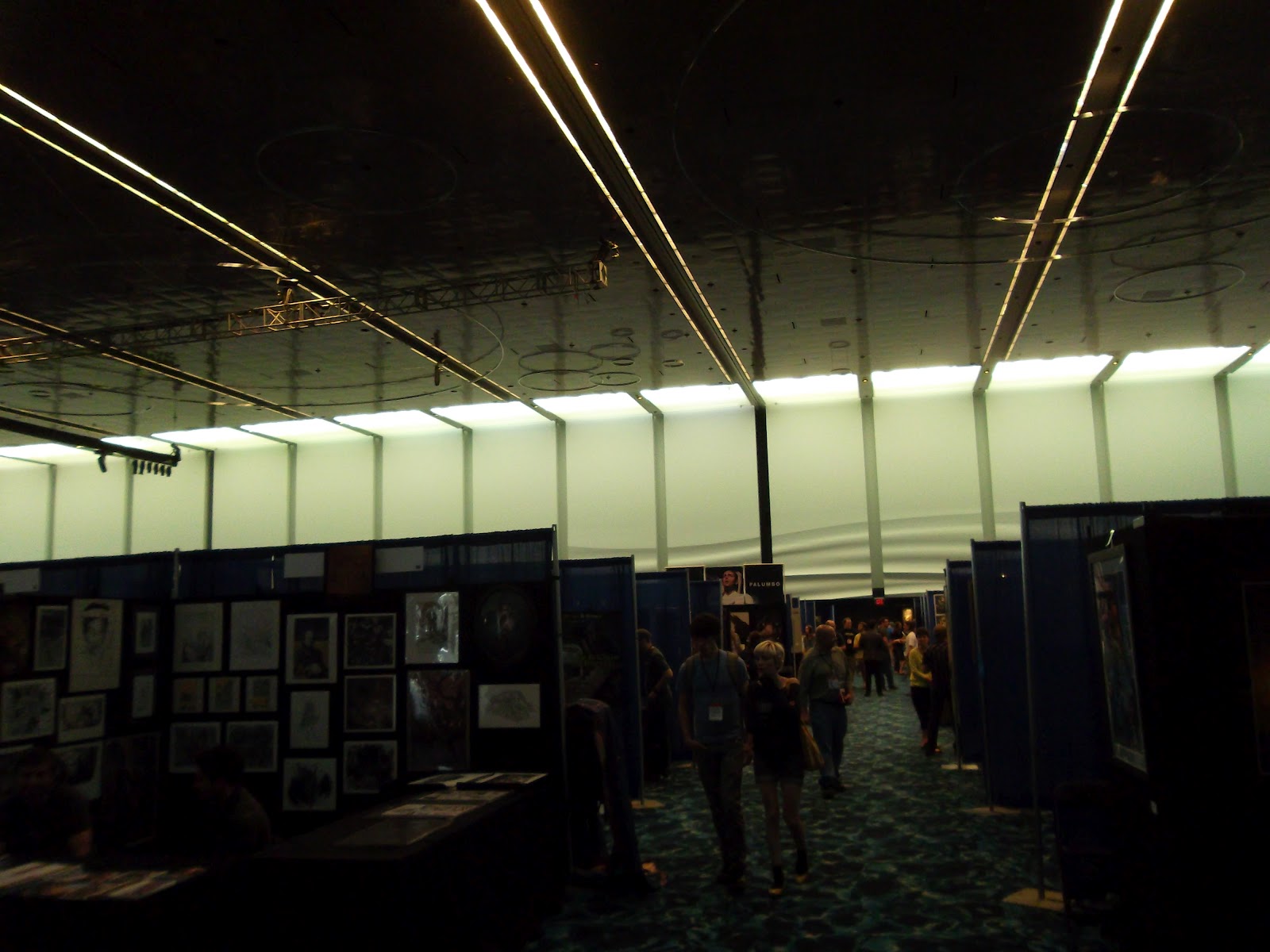
This past weekend Monkey + Seal took the long trip over to Kansas City for Spectrum Fantastic Art Live!  It was three days of being surrounded by some of the most amazing contemporary fantasy artists out there. 

The week prior was sort of a whirlwind of madness.  Seal had concept art, storyboard, and commission work to do.  Monkey had an event he was coordinating on Wednesday, then hung the latest Big Umbrella Studios show on Thursday for the opening on Friday, and he painted all weekend.  Then, it was a mad dash Monday through Wednesday to finalize transportation plans, get prints made, figure out new displays, and pack. 

Monkey ordered plastic sleeves that didn't come in on time, we didn't sleep from 1:30pm on Wednesday until we got on our plane at 2:30pm on Thursday.  There were no restaurants open by the time we rolled into our hotel at 1am Friday morning, and so we had a large amount of pretzels, snack crackers, and dried fruit for dinner.

When we arrived at the convention center the next day, Monkey started freaking out due to the sheer overwhelming amount of "big name" artists with huge original paintings and giant, framed canvas prints.  However, Seal's courage was strong enough for the both of us and as Monkey calmed down, we started to set our booth up.


Over the next three days, we got to meet some amazing artists, listen to great presentations, and we even managed to sell some merchandise.  Even though the crowd was much smaller than we had hoped, we learned a lot and came out smiling.

To be honest, it was an expensive bunch of lessons and tips (even trying to take all the budget options) we ended up investing thousands of dollars that weren't made back.  This was a bit hard to take in, but the lessons were invaluable and viewing this as an investment in our careers rather than losing money has helped ease the sticker shock considerably.
 
Rows and rows of awesome artists and art

 Some good take-aways we learned:
-It's painful and scary to be beginners.  However, what option did we have?  Pack up and quit and go home?  Nay, you just gotta do the best with what you have.  Everyone has to start somewhere.

-From Mike Mignola: If you never put out that dream project, you'll never have the chance for movie rights and other "big time" offers.  Expect to make no money and do it for the love of it, and who knows where it will go.  At least you've put it out on paper and sent it out into the world.

-When you're just starting out in fantasy illustration, 5-6 amazing pieces is all you need in your portfolio.  Take out all the filler, emphasize the "amazing" part.  Also, tailor it specifically to the company you are submitting it to.  Your portfolio for Magic:the Gathering is much different than your portfolio for book cover illustrations, which is much different that the portfolio you submit for editorial work.  

-from basically every presenter: DO WHAT YOU LOVE

-From Donato Giancola: Expect to make absolutely no sales from any craft fair/exhibition/expo, and just go for the love of it.  Think of it as investing in your career.  You'll always leave happy.

-We figured out that we have to step up our own game - we're working on designs for new display units as we type!

-Established artists are sometimes insecure and freaked out as well!  We've overheard numerous other exhibitors freaking out over who they're vending with as well.  One artist on a panel (who freelances full-time for Wizards of the Coast + others) said "I still feel like someone is going to reveal me as a fraud."  Sound familiar?
Overall we had a great time, got to (re)meet some other Bay Area illustrators and meet some of our heroes.  We have no regrets and are super thankful we were able to take the plunge and make it out to a whole new venue and a whole new level!

Award Ceremony honoring artists who won the Spectrum Silver and Gold Award
James Gurney receiving the Grand Master: an artist who has had at least 20 years in the art industry, who inspires others, and has made an impact in the community. He is Seal's hero.
Onwards! Towards more adventures!


Wednesday, May 16, 2012

Fear or Love? Your Choice


"If you try and give it your best shot, then the possibility isn't zero"

This weekend, Monkey and Seal will be on a plane towards Kansas City, Missouri for Spectrum Fantastic Art Live. We'll be vending next to some of our long-time art heroes. It's quite scary to be honest. We have never been to Kansas City. This will be our first out-of-state show. Most of the artists we'll be vending next to have at least 10-50 years of professional experience and have been published worldwide. Some of them have been doing art long before we were even born.They made the art that we looked up to as children. For Monkey, there is an artist that he has been following since he was 11 years old. We have also submitted multiple annual competitions for Spectrum, the magazine that is hosting the event, but have yet to break in and secure a published page. So going in there, we're pretty much unheard of. We are babies.

When we signed up, we didn't know what we were getting ourselves into. We thought it was going to showcase more different levels of experience, but everyone so far seems to be well established professionals. So in the last couple of days, as reality creeps on us, there is an overwhelming impulse to run away. To say, we're not ready for this. Maybe next time.

But we have this sign that we made, posted in our humble apartment when we first moved in about six years ago, "What would you do if you weren't afraid?"

So we asked ourselves, what is the worse that can happen? We don't sell a damn thing and don't make our flight money/hotel//booth back, but we can meet our heroes, geek out over artwork and life-changing workshops. Go or not go, which choice can we live with later with no regrets?

I think everyday, there is an opportunity to say yes to either fear or love. Fear of failure. Fear of embarrassment. Fear of the unknown. Fear that the journey is long and your skill level is not where you'd like it to be. We can choose those things. But we can also choose love. Love of art. Love of accomplishment. Love of pursuing something rewarding. Love of your work to have pride for it regardless of what people think of it. Love of people, artists. To recognize and acknowledge each other as unique creators. Love of the mysterious unknown. Love of the awkward growing pains. Love of yourself and how far you have personally come from.

In life we are always either running away or running towards our dreams. Why not choose the path that promises a brighter ending? After all, if you try and give it your best shot, then the possibility isn't zero. You're opening a window. You can make "impossible things, " possible, if you take a step forward.

So what can you do today to make that step towards your dream?  What are you scared of that you can embrace?  What path will you choose today that will promise a brighter future?  Grab hold, and let's take a step forward together.


Wednesday, April 18, 2012

Top 3 Ways to Kill Your Art Career

Monkey here:

So recently I've been dealing with a lot of artists recently in my various roles, and I've also been dealing with a lot of frustrations.  Most of those frustrations stems from a lack of professionalism.

The reason why stress professionalism in general so much, is that I want you to succeed.  I know how hard it can be to make a living off of art, especially when you're first starting out, and because I know how hard it can be just to create, I don't want stupid little things to get in your way.  The truth, like it or not, about the art world is that you have to do a lot of selling to find commercial success.  I'm not saying you have to make hard sales where you're schmoozing everyone you know - that's actually just annoying and kinda gross, but you do have to be able to talk up your work and make your work presentable, and the way to do that is to make yourself appear professional.

Now I'm not talking about going to gallery shows wearing suits and ties (although it might help), or that you have to carry briefcases around or anything like that.  What I am talking about is making sure that you foster your relationships with gallery curators, collectors, event coordinators, and other people who are doing their best behind the scenes to make your art look awesome so buyers can find it and give you money.

So here are the top three ways (with explanations) on how to ruin a career and look unprofessional:


1.  Be Late.
Deadline are set for a reason.  Most often than not, they are not just arbitrary times and dates made for drop-offs - curators have lives as well.  The reason I post a lot on facebook between 2am and 4am is not because I enjoy sleeping really early in the morning - it's because I'm up because I have work to do.  I don't enjoy not being able to hang out with Seal, nor do I like having to work 10-14 hour days 6-7 days a week.  But I do it because that what it takes to get things done and turned in on time.

When artists turn in pieces late, it prevents me from hanging the show.  Putting up a show (especially a group show) is more than just hanging paintings.  Sure, the physical process of hanging a show is pretty easy - measure spacing, nail/screw into a wall, hang painting, level it, done.  However, a good amount of time is spent trying how paintings interact with one another.  What is the story they're telling?  Do the colors flow?  What about size, theme, overall narrative, subject matter, style?  I can't hang a show unless all the pieces are in, and when artists are late (or worse, consistently late), I take note.  I know who I want to work with in the future.  I can also list the names of artists who I don't want to work with because of their unprofessionalism.  On a side note, there is also a list of people who I don't want to work with due to my No-Asshole rule, but that's a different blog post.

I also know other gallery owners who also have to deal with late artists.  I've stopped in to drop work off at other galleries and I've seen them stressed out about other artists.  Just as I take note of other artists who they're excited to work with to curate into Big Umbrella, I also take not of artists who they're not happy to work with.  So: be on time!

2.  Don't Follow Directions.
Whether from a curator or a boss or someone else, I'm sure you've probably gotten an email with five different deadlines, multiple directions, and all sorts of other information that makes your head spin.  While I know it's probably a lot of information, the reason people send lots of info is to try and make the project work well for everyone.

The reason that there are very specific reasons for the way I ask for submissions for outside artists for Big Umbrella Studios is because I have a crazy email inbox and I've created filters to try and keep it under control.  When you send things to other email addresses, or drop things off at the gallery, I might lose it in the craziness.  Most galleries gets hundreds (if not thousands) of submissions a year.  Well known art directors might get a hundred or more submissions a day.  If you don't want your stuff to get lost, follow directions!  If a gallery or a foundation asks for slides, one might complain about the cost/time in getting slides made.  However, the reason they're asking for slides is that that is the process in which they review submissions.  Sure, it might be old-skool, sure maybe they should get with the times, but if you want to get into their show, follow the directions, otherwise they're probably not even going to review your stuff.

Also, this has never happened to me, but I assume that if a gallery owner asks you for a painting for a clown show, you need to paint a clown.  You can get away with painting something clown-related, maybe a whoopie cushion, or maybe the green hand from the original "It" cover illustration, or maybe a portrait of someone who you think is a clown painted with a red nose, but please don't paint something completely off topic like a dragon.  If you want to paint fantasy, maybe paint a dragon eating a 17th century clown, but not just a dragon.  While I completely understand and respect your creative need (sometimes you just have to paint a dragon, or a dildo, or whatever), by agreeing to take part in a themed show, you're really agreeing to follow the general guidelines of the show.  

Think about it this way, if you worked for a whole month (or more) trying to plan a birthday party for the person  you love the most, and everyone agreed to dress up in fancy clothes, and someone shows up drunk, smelling like urine, and not wearing any pants, you'd be pretty upset.  Don't be the person not wearing any pants.  Sorry if that just got weird.  Anyway...

3.  Don't apologize or take responsibility for when you mess up.
No one is perfect.  There are times that I've been late or have been so muddled that I've forgotten how someone needs something and have had to ask for directions.  We are not all robots.  However, life happens.  Curators are people as well, and except for a few who are just assholes, we are swayed by apologies.  We are much more likely to continue our working relationship with an artist if they screw up and apologize profusely for it.  If we didn't remember to tell you the theme of the show, it's our fault, not yours.  If an artist is a day late with work and we're waiting around and they don't call or email us or text us or schedule something in advance, it's really disrespectful of our time, and we're not going to want to work with that person again.

While this is in no way of excusing being late or not following directions, if you do mess up here and there, make sure you take responsibility for it.  I highly encourage people to make things happen, regardless of how tough that might be.  Especially when you're working with someone for the first time, I'll pay a $30 cab fare to make sure that I'm there on time and with everything I promised I would have.  I'll sleep 45 minutes the night before a physically exhausting 8 hour printing job if that's what it takes to meet the deadlines, so really, if at all possible, make your commitments, but if you do mess up, make sure that the other party knows that you know that it was a mistake and that it won't happen again.

So that's it.  It seems simple, but you'd be surprised at how many artists turn paintings in late, or turn stuff in unframed when I've asked them for all their work to be ready to hang. Handle your business professionally, and clients/galleries/me will love you and ask you back again and again.

Tuesday, March 13, 2012

Monkey + Seal FAQs Answered!


Today is Monkey + Seal's 7 year anniversary, so we'll be taking the day off to celebrate. We've decided to massage our own egos by writing up this little FAQ to appease all your burning Monkey + Seal questions!

PS - It's also Seal's birthday! Happy birthday Seal!


Question: How long have you been painting?
Seal: I started dabbling about twelve years ago, but I didn't really paint seriously until about three years ago as of this Spring.

Monkey: I used to draw on my face with crayola markers when I was three, but I didn't start seriously pursuing painting until my Still Life class in 2009.

Q: How did you get to where you are? Did you go to school?
M: A long, round-about way of going to UC Berkeley to study chemical engineering, then realizing that I loved theater, then realizing that I love visual arts and storytelling even more, then going back to school for a second Bachelor's degree in illustration at the Academy of Art in SF. Along the way, I switched my major to Biology (which influences how I think of anatomy and creature design), got a job at a craft store that got me into the SF Zine Fest and the crafting world, and found out how cool silkscreen printing is. Also, lots and lots of support and help from friends who I've met along the way.

Actually, this is such a formidable question that I might post a lengthier answer in the near future.

S: I always knew I wanted to be an artist - I was a big fan of animation and film. After giving up my dream several times, I finally went back to art school in 2007, and finished in 2010.


Q: What made you go back to school?
S: I felt, at that time, that it was "now or never" and wasn't happy where I was. I didn't want to regret not pursuing art, so I made the choice to return to school. I needed structure in my learning because I really didn't have the foundation skills to really learn on my own.

M: My drawing skills were totally lame. I nearly BS'd my way into a painting MFA program without having painted in my life, but I ended up opting for the longer, harder route of actually learning how to use color, render form, tell a story, learn composition, etc. etc. etc. Thus, I knew I needed an ass-kicking structure that would teach me how to put what I see in my head down on paper.

Q: Why do you call it a "Art Cave?"
S: Because our house is cold!

M: Our apartment is dark (we get no direct sun at all) and we live on the bottom floor of a two-story Victorian. Upstairs sounds like there are rabid beasts trampling around, so I imagine this is what it is like to be in a cave. Also, we have so much stuff it sometimes feels like we're in this dark cavern of art supplies.

Additionally, our Art Cave is also the place in our head where we hide from life, as it can be easier sometimes to just squirrel away and make art rather than deal with people, obligations, work, etc. etc. etc.

Q: Seal, what is Monkey like at home? Monkey, what is Seal like away from the public?
S: Monkey does silly dances and grows six tentacles and is typing and screenprinting and is reading a book all at the same time.

M: Seal likes to play in the bath, and likes her chai tea while she paints and plays Japanese television shows in the background. She also makes cute, funny noises.

Q: Who is Monkey? Who is Seal? Why?
S: It's always the other one.

M: What does that even mean Seal? Anyway, I'm Rick, Eve is Seal, or vice-versa, whatever, and it's because I (Rick) looked like a Monkey in his baby pictures. Eve looked like a baby seal when she was little. Thus, Monkey + Seal.

Q: Does Seal like fish? Does Monkey eat bananas?
S: I like goldfish (the crackers) only. Save the tuna!

M: Surprisingly, I'm not a huge fan of bananas. I love banana-flavored candy and artificial flavoring, but I'm not huge of bananas. I do eat them, as they're a great source of Potassium and are great for being on-the-go, but yeah, I like lots of other fruit way more.

Q: What was your biggest challenge to being an artist?
S: Feeling like I want to master everything quickly but realizing that you're at the level that you are at, and that there is always more for you to learn.

M: Learning that there are no short-cuts. You just have to practice, practice, and practice some more. Then, when you're all exhausted from practicing, you gotta do it again. And again. And again...

Q: What mediums do you use?
S: Acrylic, gouache, pastels, and my favorite being Painter X. Wait, that's not true, it's Painter and acrylics together.

M: I primarily use acrylics (with gloss medium) for all my fine art stuff, and digital (Photoshop) for most of my illustration and design work. I actually really don't like Illustrator, but I am slowly learning to embrace Painter. I'm also starting to try and use acrylics for my illustrations, but have yet to really finish a piece that way.

Q: How do I get an art job?
S: Learn the foundations, and practice. Reach out. The world doesn't know what you're doing unless you tell them and surprisingly, someone will hear you.

M: Practice like a nutjob. Read as much as you can on marketing. Learn how to sell yourself. Constantly look for opportunities and take as many as you can without killing yourself. Oh yeah, and never stop the practicing.

Q: Any last thoughts?
S: If you choose to pursue art, it's a long road, but it's rewarding. You have a unique voice, so there is always something to contribute to this world - to art.

M: I really talk a lot. I also like watermelon, and regardless of what I like, you should embrace your inner artist and make sure that you do something creative today. Small steps make a big difference, and remember: there are no shortcuts to greatness.