Showing posts with label art as a profession. Show all posts

Wednesday, February 6, 2013

Creating Good Habits


Sometimes people have things that cause them to do the same thing over and over again.  Invisible scripts.  Inherent trait X.  Habits.   Whatever you want to call it, we all have them, both good or bad.  Sometimes our bad habits get in the way of being awesome, and you may stop and think "Ugh, I wish I didn't always do X."  Whether "X" is spending too much time reading celebrity gossip, or constantly checking your email instead of working, how do we break them?

First off, we have to understand why are habits so hard to break.  Habits are really neurological pathways that have been reinforced over years and years of doing them.  It's no wonder that they come so naturally to us.  They are literally wired inside our brains.  In fact, the lame part is that once we have a habit, the pathway in our brain never goes away.  So the downside is that if you have a habit of always criticizing your art as soon as you're done with it, no matter how much work you do to change that, it'll always be there, no matter what.

However, there is good news.  We can create new, positive habits that will reinforce what you want to do.  Besides, making things habitual is easier in the long run, than constantly fighting your current bad habits.

How to create positive habits?  It's about designing systems that allow you to create the habits you want through a reward system.  We need as much help as we can get when trying to replace old habits with new ones, so by creating an outside system that will encourage you to follow through.  

Want to wake up earlier?  Have an early-bird friend call you every morning to hold you accountable.  Give that friend $60 at the start of a month, and every time you don't answer your phone, they get to keep $2.  Buy your favorite breakfast food (whatever you want, whether that's Lucky Charms or creme brulee), but you only get to eat it if you wake up early.  Basically, the more reward/punishment systems you can set up to hold yourself accountable, the better. The good news is that rewarding good behaviors works faster than punishing not following through.  So make sure to get that extra box of pop tarts.

Additionally, when you do reward yourself, make sure that you enjoy the reward, guilt-free.  If you are rewarding yourself with time allotted for video games, then don't play the games and think about how you "should" be working.  Just play the games for that set amount of time and have fun.  Just like if you're rewarding yourself with cookies, don't mourn the amount of butter in the cookies, just enjoy the cookies!

To help out anyone wanting to change a habit, we'll even offer to help you out.  Email us (info [at] monkeyandseal.com) with your name, email, and habit that you want to create, and we'll email you once a day for a week to offer words of encouragement and check in with you.  You can do it!  Start building a good habit today!

Thursday, December 20, 2012

End of the Year Reflection


Hi Friends!

This will be our last post for 2012. Hope everyone has had a wonderful year, and we'll see you with new adventures in 2013!

-
As with every end of the year, we'd like to take stock of everything that's happened within the last year and reflect/ appreciate/ and celebrate the challenges and growth it took for us to be here today.  We also want to share with you our dreams and goals/themes for the next year.

Seal's accomplishments:
  • Worked on 3 films: a feature film, a cg animated short, and a live action short that involved giant green screens and riding a fast moving contraption down Embarcadero.
  • Skyace Wasteland (personal graphic novel/ animation) 1st chapter written
  • The Daughter and the Ogre (graphic novel) full story written & storyboarded
  • Learned incorporating Gouache & Watercolor in concept art
  • Painted 3 colorscripts
  • Gallery Show in March: Rusted Souls at 1AM
  • New painting techniques experimented with since July, finally came to fruition in December.

Monkey's accomplishments:
  • Dark Wizard's One-Stop Shop new concept/ story
  • Big Umbrella Studios reaches its 2 years with current owners
  • Design and printed for Facebook.
  • Invited to speak at Alumni Artist/Freelancer Panel
  • Story Collection: White Mask, (list, etc).
  • Learned how to paint on windows
  • Invited to live-paint at RAW SF. twice!
  • Revamped website and integrated blog

Monkey + Seal's accomplishments
  • Our very first out of state show among out heroes and legends at Spectrum Live! in Kansas City, Missouri
  • Our very first out of city show in Sacramento
  • J-Pop Show (July at Big Umbrella Studios)
  • New Tshirt Design "Not Bad, Just Different"
  • Taught drawing class to artists/ designers from Apple, Inc.
  • Both of us were invited to live paint for Hyphen magazine's 10 year anniversary
  • upgraded display with new IKEA tie racks
  • Broke our personal records at every show this year: Zinefest, A.P.E., and BazBiz Holiday Show
  • Started showcasing originals at live craft shows
  • Protested city college's closing of Fort Mason campus

While we've had a lot of great accomplishments, we've also had our share of trials and tribulations as well.  Over 2012 we've dealt with fights with colleagues, deaths in the family, financial strain, and countless bouts of self-doubt, fear, procrastination, and other self-destructive behavior.  Regardless, we count ourselves extremely lucky that we're able to continue to do what we love to do, and that we can continue to support and inspire other artists to do the same.

We've recently realized that instead of focusing on single goals (single markers of accomplishment that will always be surpassed), we should instead be focusing on themes (ongoing processes that are enjoyable and that bring you happiness).


Our Themes for 2013:
Monkey: "I will create more personal work and put more of my artwork and vision into the world. I want to find and cultivate a larger audience for my dark/horror inspired art and to somehow give back to my community of artists."

Seal: "I will continue story development for films and concept art with my awesome team. I'll develop more personal work/ direction (ie. graphic novel/ story writing/ painting series) and will cultivate the art community. I also will find more inspiring people and projects to work on."

Instead of making New Year's Resolutions, we'd like to encourage you to choose a theme that you'd like to pursue.  Instead of "draw everyday" (which, if you miss a single day, you feel guilty about breaking your commitment and you give up), think about "be sustainably more creative."  Instead of "I want a million dollars," think "I will create a source or sources of income that will allow me to sustainably grow my standard of living."  Goals are finite, and if you reach them, you have to make new goals.  Themes, on the other hand, are larger pursuits which will find you achieving your goals along the way.


So if you have any suggestions or ideas that could help us along with our themes, we'd love to hear from you.  And we'd love to hear some themes that you're thinking of taking up in 2013.  By taking the leap and putting it down in the comments, you're much more likely to follow through.  Let's make 2013 our year to shine!


Wednesday, December 12, 2012

You Must Not Quit Yourself


"When I was in high school I was advised that it's difficult to have an occupation doing something you like, and that it's good to do something you somewhat like. I went against this advice, and now I'm glad that I did. If I only somewhat liked this work, I'm sure I would have quit by now. Doing what you like equals yourself, and you must not quit yourself." - Takehiko Inoue
Seal here.


Today I wanted to share the words of wisdom from one of my favorite manga writer/ artist, Takehiko Inoue. He is best known for the successful manga/comic sagas: the basketball manga Slam Dunk and the wandering swordsman manga, Vagabond. They have both been made into anime, tv drama series, and life action films.

Often times, Seal is racked by her past "failures." Mainly that it took me so long just to acknowledge that my true dream was art, and that I was an artist, and to finally pursue it wholeheartedly. Somewhere a couple of years ago, in the middle of a job that was not art, rising to the top in a career that society approved of, but feeling empty inside, I realized: you can fool everyone else, you can convince everyone else but you can never cheat yourself.

Have you followed a dream to end of the line? Have you given yourself permission to pursue it? What does it look like when you've crossed the line and completed a dream?
So what is your true love? If you can allow it, what is your dream?


Monkey here.

When I was growing up, all I wanted to be was a comic book artist.  I loved to draw, and, with no knowledge of the pay-per-page rates, the tight deadlines, or the crazy amounts of research and practice involved, I declared I wanted to be a comic book artist.  Something about being able to make awesome art that told a cool story filled me with joy.

I quickly forgot all that as I started public school, focusing more on the academics that came easily to me and that brought me praise.  I ended up going to a prestigious university as a Freshman, and quickly came to realize that given total freedom, I was not a Chemical Engineer at all, but an actor!  I ended up running an Asian American theater group for a while, competed in some poetry slams and theatrical readings, and met Seal. 

Seal bought me my first sketchbook (that wasn't a black and white composition book).  I graduated, found a high-paying recruiting job, and promptly quit after a month to go back to art school.  There, I realized how much blood, sweat, and tears becoming a technically proficient visual artist requires.  I started out as a graphic designer, then an illustrator, then finally took my senior classes in fine art.  Somehow I graduated with a hodge-podge of random classes that are part of no single degree program.  There, I realized that I was not into what the school was teaching.  While I was and still am extremely grateful for the skills I developed there, I realized that the path of the fine art students doing senior shows and the illustration students doing concept art and editorial illustrations was not mine.

Fast forward three years.  I slowly but surely create and self-publish my own comics.  Some are drawn poorly.  Others are more like illustrated short stories.  I've come to realize that more than any job title, or what you do to make a living (retail wage slave for 5.5 years, baby!), who you are is something powerful that is absolutely essential to find if you want to be happy.

No amount of money, power, or love is going to make up the void left in you if you are not being true to yourself.

It is, of course, not mutually exclusive to be rich, powerful, and have important loved ones in your life and be true to yourself, but all those other things don't make up for finding your essential self and embracing it.

I am a storyteller.  Whether that takes the form of theater, spoken word, short stories, flash fiction, comics, paintings, t-shirt designs, blogging, or even just telling long-winded jokes to friends over beers, I've realized that the thing that first pushed me towards comics is a love for stories.

As 2012 comes to a close, have you found who you are?  If not, what's holding you back?  I know the truth might be scary, or intimidating, but really, the truth will set you free.

Wednesday, December 5, 2012

Selling Out is Hard To Do

As an artist, it might seem frustrating at times to keep going.  If you are not getting the accolades or sales you want of your work, it can be discouraging to continue to do what you like.  Often you might question whether or not you should change your subject matter/style to "fit in."

Monkey was privileged to be able to sit on an Academy of Art Alumni panel on the topic of Getting into Galleries.  One question that really struck a chord with him was "Should I paint what sells, or what I want to paint?"

We think that there is a perception (true or not), that either abstract art, highly conceptual art (think soup cans or diamond-encrusted skulls), or classical landscapes and portraits is what's in demand.  Regardless of the truth of the matter, especially if you go through classical training, these types of paintings are what you think sell.

If you try and paint these things, when you really would rather be painting silly monsters or unicorns or whatever, you will not do well.  Trying to sell out is actually really hard to do.  Sure, you might start selling paintings, or you might start getting lots of praise for your new work, but if you don't like it, you won't be happy.

Making art is such a personal thing that you can't force it.  Well, you can force it, but it'll lead to you disliking or even hating your own art, and it'll become another ball and chain job that you have to do even though it kills you.

Monkey used to think that no matter what it was, he'd be happy to be paid to make art.  Then, as he actually started getting paid to make stuff, he realized that he only really likes making stuff that he wants to make.  The thought of being told to make piece of art that he was totally uninterested in was even more difficult that dealing with the daily hurdles of working retail.

Really, selling out is easy to do, but hard to keep up.

Now, we want to stress that we totally understand.  People have bills to pay, food to buy, etc. etc.  If you have to take those dog portrait gigs or doing background paintings for porno or working crazy hours at a game company or whatever, we're not judging.  But for all of you out there who ever feel discouraged, or that your art doesn't have a place in the world, please know that it does.

There is an audience for you out there.  It might not be the largest audience, but it's out there, you just have to look.  The internet is amazing at helping people find micro-subcultures, and if you feel like your work isn't attractive to the mainstream, then experiment showing your work elsewhere. It might take time.  It'll probably take a lot of work.  But know that the long hours and hard work and all the experiments that don't work will all be worth it in the end when you find your niche and can truly be yourself.

So keep in mind that you need to keep on doing what you love.  Have fun.  That's what art is supposed to be about.  If you're happy and having a great time, that feeling comes through the work and it shows.  People can tell when you're enjoying yourself, and it will naturally bring more happiness and joy.  Create what you want and seek out your audience, and trust us, you'll do just fine.


Wednesday, October 31, 2012

Working + Resting

There is a myth among artists, that you are either “lazy” – “not creating as much as you should be” or you are a “hustler” – “always working without rest.” They are both false and dangerous myths. There doesn’t seem to be room in the equation for a moderate, sustainable and successful artist. It’s rare to meet such a person: who can be both creative, hardworking, yet also has a healthy social life and rest periods. We don’t seem to have much role models in the “balanced artist” department.


Seal grew up watching her immigrant parents worked hard to the bone. They ran themselves ragged trying to meet the family’s basic needs. Sometimes they work two jobs, both the day and night shift. But when her family acquired enough to live by, and sometimes more than enough, her parents who had been working all their lives also did not know how to take a break. When they came home from work, they would hurry unto the next cleaning or cooking project. When Sunday came around, Dad would start vacuuming the house at 8am. He would burst into the bedroom with the vacuum roaring and made sure to hit every corner before he walked out again and slammed the door. I got the message that I was lazy for sleeping past 8am. When my sister and I tried to watch Batman weekdays at 5pm after completing our homework, they would glare at us funny. As if, “resting and fun time is only for the lazy” and “if you want to be successful in life, you better spend your waking moments working.”

So growing up, Seal thought “breaks were bad” and even if she wanted to, she did not know “how to take a break.” I bet most of us, don’t know how to rest either.

Oftentimes, Monkey + Seal run rampart into the night making art, emailing clients, turning in projects. We often run on very little sleep or break. Most of the time, it is because we are trying to make ends meet or deliver work that cannot wait. But other times, we choose to stay late and push through our own self-imposed deadlines (although we are trying to change that). The result is, we sure get a lot done, but we’re also cranky, exhausted, and deprived of rest and life outside of work or art. We often forget that “how you spend your day is how you spend your life . . . “ And if your life is all about work and art with very little room for friends, self care, or rest, then you’re really running yourself into the ground without enjoying the journey of being an artist. One day you will wake up and realize that life had passed you by.

Though Seal would like to blame her parents for passing on their workaholism, as an adult now, she realizes that it is up to Seal to allow herself a break and if she doesn’t know how to break, she needs to learn. Only she can break the spell now and wake up. To know that it’s ok to take breaks. It’s normal to take breaks. We all need it, as we need air to breathe and food to sustain us. Our bodies need to regenerate. Our minds need to refill the creative well. And counter to beliefs, breaks allow a person to actually be more productive and resilient through the next strenuous work challenges.

So as Seal is learning on how to take a break, she would like to share some guidelines that she found to be helpful:


  1. When you’re tired, take a break. Think as if you are a baby. When a baby is tired, it gets cranky. So we put the baby to sleep. When Seal is tired, her eyes get heavy, she will start munching on something even though she’s not hungry, and she’ll get really annoyed at every little thing. That’s when the red lights go off. Oh oh! Body is deprived. Need a bath, tea time,10minute shut eye, or a full nap. You’ll figure out your own personal cues to tell you that you are tired.
  1. Figure out what constitutes as a “break” or “rest” for you. No emails after 6pm. Tea time at 4pm. Sleep 8 hours regardless (if you have flexible schedule). A movie night. Music for 15minutes with eyes closed. Everyone has different ways of feeling “rested.”
  1. Resting while in Motion or in order words Resting while Working Sometimes it feels like there is no choice to but to work a lot. Especially when rent is due, bills are piled up, or client project is on the line. In cases like those, we still need to be proactive and “choose” to work. Focus on the brush contacting the canvas. Focus on the words being t-y-p-e-d into the email. Focus on the present moment of breathing in and out, hearing the hum of the computer. Focus on the voice of your client. See if you can find the breath of all things even within the “mundane.” That way, when you are super focused, work won’t feel like work. And you’ll get it done twice as fast.
  1. Know when “it is enough” You are enough. Stop. A big part of the reason that it’s hard to rest and be successful is that we don’t know when it is enough. When it’s time to rest or when it’s time to push against the mountain. We often confuse satisfaction/happiness with “career success.” Many are too often fixated on being bigger and better that we don’t enjoy the process. We are so focused on learning new skills as an artist, absorbed in our chosen field (because we love it so much) that we’ve buried our heads in the sand like ostriches, and are blind to the beauty of a simple walk through the neighborhood, a cup of coffee with a friend, or the passing of clouds after a rainy day. At some point you’ve got to realize, that although life for an artist is about the art, at the same time, it is also not about the art. When you are six feet underground, you still can’t take your “art,” you skills, or your accomplishments with you to the other side. You’ve got to be fulfilled in the present.


The best part of being an artist is living in the now. Being present at the moment. And whether you are working or resting, being aware of your breath and that you are alive, is the start to being a balanced artist: one that can see work and rest and two sides of the same coin à both starts and ends with fulfillment.

Wednesday, October 24, 2012

Money + Art

  -->
“Beautiful work!” Seal said to an artist who had a booth at APE.

“Yeah, but I don’t do it full-time,” he countered, “I’m not a professional yet,” he flustered. “I’m not PAID for it yet.” Seal heard the door of a heart slammed shut.

“But your work is beautiful!” She protested. “Whether you are paid for it or not, it doesn’t take away the fact that it’s still beautiful and people notice it.” (A young couple lingers around his table and drops $7 for one of his prints. I look at him in confirmation, see?

“I guess,” he said with a sigh, “but I’m still not paid the ‘big bucks’ and uh, this is a local show, once I get into a National or International gallery, then . . .  then . . . “ he shook his finger at me and trailed off. The entire convention center became very boisterous. I am left alone to my thoughts and I suddenly become very angry.

“Then . . .” WHAT? You can finally believe me? Only when you’re paid the “big bucks” or in a “big institution somewhere” then you will believe that your work is actually beautiful as people think it is? When you get paid and other institutions recognize you, THEN you can finally embrace yourself as an artist? Or “better” yet as a professional artist? You are waiting around for some big institution or high-end client to swoop down from somewhere to come “save you,” and lavish over you art, especially when art is very personal and very subjective and money and pricing proned to inflation, you are waiting and waiting for someone outside of yourself to say that you are a professional artist?

Dude, you’re living in the future that may or may not come while ignoring all the people who are stopping by your table to admire your work. Whether people pay $3 for your art of $30,000 – it is still beautiful.

Don’t discount your artwork! Just because it doesn’t readily translate to big monetary equivalent.

Money is very very subjective. At craftshows, we’ve had “rich” costumers throw their crisp $20 bucks at us for a tshirt, vs. a young boy who was clutching his only $20 allowance and after circling the entire craftshow and our booth 3-4 times, he wholeheartedly gave us his entire savings for a “Create or Die” tshirt. Even though both instances were a purchase of $20, that 20 was worth a world apart difference to us.

It took Seal a while to learn that money or big institutions will never equal to the value of one’s art.

Most everyone I know, including myself, has a money problem. Artists often have double the trouble because we equate money with recognition and value of our work. Given all the myths we’ve heard about being an artist, it’s no wonder why it’s hard to untangle: “art doesn’t make money,” “if you make money as an artist, you’re a sell out,” “art for art’s sake” (don’t pay for it?), “money is greed” “if you become too tall, they’ll cut you at the base” “starving artist” “art is superfluous” “art is selfish” etc etc. It doesn’t help to have a society that is rather unaffected or diminishing towards artists. While other occupations usually have a standard starting pay (think doctors, mechanics, etc.), an artist can be paid anywhere from nothing (a free service) to $100,000 or more for an art piece.

Of course, it’s a challenge to know your true value as an artist. But let me tell you a secret, money isn’t it. Money will never equal the value of your art.

For a long time, especially throughout art school, Seal kept hoping that a big studio would pick her up. Then . . . then . . . she would be recognized for her work. Then . . . only then . . . will people value her. It was the magic pill. Suddenly, if she worked at a big institution, everything will be solved: she would always be creative, she wouldn’t be proned to roller coaster rides of artistic blocks. She would have peer recognition and money (something she didn’t grow up with) and could buy all the reference books and canvases she wants (instead of scouring for found objects, antiques, and wood to paint on). Then, she would be paid the “big bucks” and be labeled a “professional artist.” Then . . . then . . . the prince comes in a magic pumpkin carriage . . .

But this is not reality.

Whether you work full-time, part-time, contract, intership, or as a hobby in art . . . You will still have to deal with artist blocks – it’s part of the process. Whether you are at a big studio, small studio, or in the humble corner of your apartment making art . . . you will have to deal with the day to day frustrations and existential crises of being an artist, you will always have deadlines to meet and critics to face, you will always have to feel unsure when you put your work up. You will still probably have to deal with naysayers and family members who may or may not support you. Whether you are showered with praise, some or not at all, or whether you are paid big, small, or none at all . . . at the end of the day, you will still have to face the biggest challenge – yourself. Do you value yourself as an artist? If money were non-existent and you were the only living human in the world, would you still create art? Would you have fun doing it? Is your current project challenging you as a person?  Does it makes a statement about you as a person? Are you SATISFIED? FULFILLED?

When Seal takes away the myth of getting paid the big bucks and being in a big institution, she finds that she is just very happy to be creating art. She works on an independent film set with inspiring and creative people. Her voice is heard by the director and she can make positive contributions on the project and the people around her. At night, she explores her paintings further. Her limitations on money actually help her to be more creative, as she is forced to find alternative surfaces and new ways to approach a painting. She finds rare antique wood and unthinkable items to incorporate into her art and has expanded beyond the canvas. And people actually like her works on wood better than on canvas as they all have unique grain and texture. She is learning multiple ways to tell stories, to make art, and find her inner voice. She paints and creates comics as she wants. And she’s surrounded by warm encouraging friends who are excited for her and her art. She is in the journey towards knowing herself. She no longer lives in the future, but at the present moment enjoying her life and art-making.

Because the artist at APE is still waiting around for his “big chance,” when it actually comes in the form of people complimenting and buying art from his table, he didn’t notice that he is currently living his dreams, making art and being PAID for it. It was as if he was living on the ground breathing his dreams of being an artist, but still looking hopefully at the sky for something else. He’s waiting around for someone, something outside of himself to ordain him as a professionally paid artist. In the end, it’s not really money or big institution he wants. What he actually wants is someone, something “out there” to shut the critics in his brain and answer the burning question, “am I good enough as an artist?”

And no amount of money or outside recognition will ever fill up that hole, but yourself.

You are enough. You can begin it now. As you are.

Don’t wait for your life to start, to value yourself as an artist. Don’t give power to something outside of yourself to make or break your artistic endeavors. Don’t wait for the big bucks or the big institutions. Because at the end of the day, do you want to create or not? Are you having fun or not? Do you respect yourself as an artist or not?

Sure, having money is nice. And working in a big institution – if it fosters you and is aligned with your values and priorities – is nice too! It’s more than ok to want money or full time work as an artist. And you should definitely be paid for work that you do. And if you live on this earth with other people, you cannot avoid acquiring and spending money on something. We all need shelter, food, and ways to make our art, and even indulgences. But money or big institution should never be the measuring stick for satisfaction, and can never substitute the longing for the final verdict of  “I am a worthy artist.”

If you are living and breathing, you are worthy already. If you are creating, you are worthy already. So start now. Begin and live in the present moment. And create. Live your life because you are a million bucks already.

Wednesday, October 17, 2012

How to Be Selfish + Selfless


We're back!  

Sorry for the long hiatus everyone.  For all you that are our facebook fans, you'll know that Monkey ended up with strep throat two weeks ago (and most of last week as well), thus much of our focus was on healing him up.  Seal was an excellent nurse, and did much to make sure Monkey didn't die.

Anyway, today we wanted to talk about selfishness.  Our society often gives mixed messages about selfishness.  We often see stories of people who are so obsessed with something (music, art, business, technology, etc.) that they devote their lives to it and selfishly put that love over everything else.  We are told this is the epitome of the American Dream of pulling yourself up by your own bootstraps and following your passion.

We also, however, often get the message that we shouldn't be selfish.  That we should think of society as a whole, that it's saintly to give to others and to give back to the community.  We praise non-profits and community giving and we are often socially rewarded for doing "selfless" things.  Also, especially in certain communities, (religious, immigrant, and/or minority) communities, emphasis can be strongly put on the community over the whole.  Pressure to "put the community over your own needs" can be strong, and it seems like the right thing to do is to be selfless.

However, we'd like to offer a different take on selfishness/selflessness.  We propose that if you live your live following your dream, it is not only the right thing to do, but it is the most selfless and selfish thing you can do.

Paradox time?  Not really.  You see, by following your dream, inherently you are being selfish.  But this is a good selfish.  You need to be listening to your Inner Artist and following that dream of yours because that is really what you were meant to do.  Your dream is unique, and by doing what you love, you're being the best person you can be, and you need to be relentlessly selfish about this - you can't put it aside for other people, whether it's your dying mother in Bolivia or your favorite teacher, or your boss, or your pastor.  

No matter who tells you otherwise, you need to live up to your full potential and follow your dream.  

At the same time that you're ploughing ahead looking after yourself, realize that by doing that, you're offering your gift to the world.  Maybe it's your unique way you look at the world (visual artists), or your pursuit of a new taste (culinary artist), or maybe it's an exploration of what the human body can do (dancers and performing artists).  Regardless, your dream is yours alone and if you can find that voice and follow it, you will reach your full, awesome potential.  

By being the best person you can be, you will undoubtably come across ways to give back.  Whether it's performing at a charity ball, or donating your art for a fundraiser, or maybe it's creating a path for an underrepresented group of people to follow in your footsteps, you will be able to give back selflessly while you selfishly pursue your own dream.  

As Chris Guillebeau puts it, you will be able to become a true key dropper.  As your dream manifests itself via your own selfish motivations and actions, make sure that when it's possible to do so, help out others along the way.  Drop keys for people to open doors.  Don't create cells by trying to shut out people asking for advice - drop keys.  

So go out there and do something for yourself.  Put yourself on that path towards following your dream, and opportunities to give back to your communities and the people who help you along will manifest themselves.  Don't hold anything back, and go after what YOU want.  

Wednesday, September 12, 2012

Don't Hold Anything Back


Monkey talks a lot about business sometimes, but even more important over the course of your entire life is the art itself.  Too often we might focus on what is going to take us to the path of the "professional" artist the fastest, when we ignore what might be best for our inner artist in the long run.

We often talk about the "hustle" and the drive to make sure that you get your art out there.  We talk about marketing (Monkey even wrote a book on selling your art), but we want to take this opportunity to emphasize on how important it is to nourish your inner artist's soul.

Yes, we all need to make money, and yes, if we can make money off our art, then we can do more of what we love.  That's why Monkey is always on your case to get your hustle on.  BUT!  The sneaky seemingly perplexing truth of it all is that you have to do more of what you love regardless of your circumstances.  Jobs and opportunities and all that stuff follows if you just do what you love.

Sure, this may sound new-age hocus-pocusy wackiness, but it's true.  The one minor huge caveat is that you can't hold anything back.  If painting is what you love, and you're trying to do a specific style, or if you're trying to stay focused on one single thing (when you don't really want to focus), then you're holding back.  If you feel this overwhelming urge to paint an elephant playing soccer but you have to finish your homework, you're holding back.  If you desperately need to paint something dark and painful from your past, but are afraid to, you're holding back.  If you let people tell you "you're too ____," or "you're not  ____ enough," or "your work is missing ____," and you believe them, you're holding something back.

So you've got to take your brush in your hand and let it explode.  Don't hold anything back.  If you need to attack the canvas, do so.  If you need to coax out the art with a gentle touch, do so.  Whatever form it takes, by embracing that uniqueness, that essence that is undeniably YOU, let it out.  For better or worse, by inhibiting what you really want to do, you'll never really reach the heights that you were meant to soar to.

So while you may feel the pressure to get your hustle on, that is even more of a reason why you need to embrace your inner artist and really let it rip.  Don't hold back.  We know it's scary as hell, but if you're going to dive in, you have to dive deep and really let yourself explode into the awesome artist that we know you are.

So get out there and don't hold anything back.

Wednesday, August 1, 2012

Top 3 Reasons To Be A Solo Artist


Some say that it's better to go it alone in life.  After all, you only have yourself to take care of, nothing to hold you down, and plus you get to take all the credit for yourself.  Who would want to find a close-knit, supportive community of artists?  Who wants artist friends or a support group of others who have been there and done that?

We assume you don't, so today, we wanted to bring you the top 3 Reasons Why You Shouldn't Find An Artist Community.

1.  You Don't Want To Get Far

Finding a community of artists, whether it's in person or via online, usually helps you create connections with other artists.  Monkey + Seal have found that through these connections, we've been able to both help careers along, as well as be helped ourselves.  Through our networks, we've found jobs, gigs, cool new opportunities, and friends.  So if you don't want any of that, and you want to slave away by yourself doing everything the hardest way possible, please, by all means, stay away from communities.

By communities, we mean don't find friends who like to go to gallery openings, or don't join online communities like Deviant Art or various Facebook and LinkedIn Groups.  If you went to art school, make sure you cut off all contact with your classmates and former teachers, and don't take part in any alumni groups or meet-ups.

For the love of all that is holy, make sure you stay away from communal art groups, or drawing meet-ups, or any sort of art making that might happen in a public place with other people - these are the most dangerous of all if you want to fly solo.

2.  You Enjoy Artists' Block

Often times, when we get stuck in the process of creating, besides pushing through it, an easy way to get past it is to find new inspiration, or ask for help from other artists who you trust.  We're sure you can see where we're going with this.

If you enjoy the gut-wrenching frustration of Artists' Block, be sure to not make other artist friends who you can get opinions from.  Definitely don't live with another artist, as we've found that living together has shattered our Artists' Block countless times.

Other artists provide new insights into our own work, or perhaps they might share a resource that might inspire you or give you more information that you needed to push through.  Maybe a fresh pair of eyes might help that composition you were struggling with, or maybe they've worked with an epoxy that might help out your sagging sculpture that you've been fighting.

So please, if you just absolutely love getting stuck and not being able to get past the block that stops you, make sure that you don't make other friends who are artists!

3. You Love Feeling Unsafe and Like Poop

Multiple rejections are a part of being a professional artist.  Our field is highly subjective, and having a barrage of blows to your self-confidence can be crippling if you're by yourself.  Obviously, if you love feeling beat down and potentially scared to make art, having a group of like-minded people alongside you to remind you that your art IS VALUABLE and IS IMPORTANT would not be your cup of tea.

Having a network of other people who have been there, or are there fighting alongside you can help restore your confidence.  Hearing stories of successful artist friends who have also been rejected or have had to submit portfolios again and again to finally land that dream job can really help someone who is going through the rough time that being an artist can entail.  So if you don't like to feel great and be reminded about how totally subjective our field is, then please, stay away from artist communities.

You need to be especially wary of having good artist friends who are willing to honestly and safely critique your work when you are trying new things.  Whether it's a new style, subject matter, or new medium, showing it to your core group of trusted artist homies probably isn't a good thing if you want to be ruthlessly beat down and told you suck.  If you want to feel like crap, create for a void, where you will have no one to validate your ideas, and you can let that monstrous whirlwind of self-doubt win out over your logical mind and crush your artistic dreams forever.

So please, dear artists, if you have any disregard for your own artist's soul, your artistic well-being, your ability to create, or your professional career, please, stay away from finding your tribe.  Don't make close friends who you can trust to nurture your art and your vision.  Stay away from artist communities that foster new work and will help you grow both as an artist and a professional.  Please, please, please do not continue to read this blog, as Monkey + Seal are working to create a new community of artists who are supportive and caring over competitive and criticizing.  Don't look for our new updates on how to become members of the upcoming online cabal of artists!

Wednesday, July 18, 2012

Keeping It Fresh - Fighting Apathy


Over the course of an artist's career, you may find yourself getting apathetic about art.  WHAT?  How can that be?  Art is my lifeblood!!  We can hear the collective gasps.

But seriously, when you're doing art for a living, you can start feeling almost hostile to it.  But it's not like you're putting it off because you're procrastinating:

"Hey you painting, shut up!  Just sit over there in that corner, unfinished, and don't bother me until I'm done with this super-important game of Settlers online!"

It's more like you know the painting is unfinished, but you've stopped caring.

"Huh?  Oh yeah, hey painting.  Not done?  Wait, what's for lunch again?"

Obviously, this is not a good thing.  No one wants to find that you have stopped caring about what is supposed to be your passion in life - then it wasn't your passion in the first place, right?

Wrong.  If you're finding that the single thing that you've loved to do isn't getting you excited, it's probably because you 1) have not been rewarded properly, 2) are overworked, or 3) a combination of the two.

How do you shake this funk off and get on with it?  First, we should identify why you're feeling apathetic, and then we can talk about how to freshen up your mood.

If you're doing art (especially art you actually care about), but it's not gaining any traction, it's easy to get discouraged.  Maybe you're doing stuff you love but for a boss who doesn't care.  Or perhaps you've just designed the coolest building ever, but the client wants something boring.  Or maybe you've busted your ass to come up with a whole new body of work but people keep telling you that they like your older work better.  Whatever it is, if you've been working hard and were really excited about whatever you were doing, the biggest buzzkill is for other to not share your excitement.

You see, apathy usually is created as a form of self-defense.  Because you've been disappointed in the past, your brain tells you that you shouldn't try as hard, or that maybe you shouldn't try at all, because it doesn't want to get disappointed again.  Just like with most things, you are your own worst enemy.  The more you care about something and the more that care doesn't get translated into rewards (whether that's winning a prize or getting lots of compliments or selling a piece), in the case of apathy you start to get discouraged, and think "Well, it wasn't what I really wanted anyway."

A slightly different instance that might create apathy is known in some circles as "just plain exhaustion."  If you're being overworked, chances are that you're just literally too tired to create.  Whether you're being overworked in your art or a volunteer position or in a job, your body is trying to save itself from exploding in a huge ball of fatigue, stress, lack of sleep, and what is probably a bunch of caffeine, sugars, and other things that you stuff yourself full of to keep going without having to pause to eat a healthy meal.  Once again, your body is kicking into self-defense mode to preserve you: "Eh, it's not really that important to me.  Well, that frees up some time to maybe nap or actually eat something."

In either/both cases, the feelings of apathy are created as a means of self-preservation.  It's either fear or lack of energy that's causing your body and mind to literally avoid your art.  To be honest, getting excited about your work and doing it takes up a lot of emotional and physical energy, and your body is lacking either or both.

So how do you keep it fresh and re-energize yourself so that you can find your passion?  Well, we hope it's obvious  how to fix the second scenario - the one where you're running on fumes (if it's not - remember sustainability and take care of yourself!  Get some sleep!  Rest!  Meditate and destress!) However, for the emotional side of things, it really helps to take a step back and remember why you're an artist in the first place.

You're an artist because you love to create.  Sure, we'd all love to make a million dollars off of every creation we make, but really, you still go out there and create because you love to do it.  Deep down, we just want to create, but because we live in a world of media hounds and capitalism, these outside indicators of success (praise, money, etc) have grown to replace that inner joy you get from making something that you love.

External success are usually a good thing, but when the business end of art becomes more important than making art, we're losing a crucial part of ourselves, and we start to rely on that outside affirmation for the buzz that we used to get just from creating.  This is usually okay if you're getting all those outside indicators, but we feel like you shouldn't rely on it.  What happens if you stop getting praised, or sales of your work has slowed?  

So in the end, you have to treat creation like you'd treat a relationship.  After years, you may think you know most everything about your partner, you might fall into a comfortable routine, you might sort let yourself go.  Long-term relationships, like the one you have with your art, are all about communication and keeping it interesting.  The best thing is that you're not committed to your art like you probably should be with your partner - your oils aren't going to get jealous if you go dabble in some collage or printmaking.  Maybe you should try painting in a new style, or maybe you just need to take a small break.

The key to fighting apathy is really to rekindle that love you have for creation.  As your career progresses, there's a lot of pressure to "make something good" or "create something that sells," but you need to keep in mind that art should be fun.  Let yourself make something without judgment of whether it's good or not - just make sure it's fun.  Draw a stick-figure comic if you're a photorealist painter, or go take some photos if you're a writer, or write a short story if you're a woodcarver.  Just remember to have fun and to savor that feeling of creating just for creation's sake.  You'll remember why you picked up art in the first place.


Wednesday, July 4, 2012

Put Off Your Project To Get Off Your Ass


While some of you out there may be struggling to get inspired to create, there are some artists out there who struggle with an overflow of ideas.  While at first glance, this might seem like an awesome thing, but it can be paralyzing to have hundreds of different ideas in your head that you want to express, yet you don't know where to start.

Maybe you have a story for a graphic novel or three, as well as some character designs you'd like to do, and an idea for a film, and a photography project you'd like, as well as some t-shirt designs and ideas for your wedding invitation design, etc. etc. etc.  The list goes on, and you maybe are just overflowing with stuff you want to do, but there's never enough time to do all of it (especially if you're also doing a day job, juggling obligations to friends and family, and you know, living life.)

If you don't suffer from this dilemma, one might not understand how potentially crippling this is.  You might say "Yeah, but at least you got ideas," but the truth is it is sort of like being given your choice of being able to eat one single dish of anything you'd like in the world.  You start thinking "I really like this..but what about..this?"  You don't want to waste this awesome opportunity, so you start weighing your options.  You really want the seared swordfish with the mango salsa, but then you've never tried the sauteed water spinach with 17 different herbs and marinated tofu.  But you don't even know if you like tofu or if you'll get sick of it, because there's also that weird thing that you've never eaten because it's $200 a pound, but what if you don't like it...you know nothing about it, so you start to google everything, and then it becomes one big massive information overload and the clock is ticking and you're not even eating anything but you're starting to salivate thinking about all this awesome food and it sucks that you only get to choose one thing, but what do you choose since everything looks so good and while you might want something familiar are you really going to blow this chance to try ANYTHING over a simple bowl of mac and cheese?

Yep, that's sort of what idea-overload is like.

If you do suffer from idea-overload, you'll probably be familiar with the overwhelming sense of confusion over what to do right now.  Sure, you know that you want to do all of these things, but where do you start?  It's so daunting to have five bazillion long-term projects that you want to do.  What project do you prioritize?  You don't want to lose steam or forget an idea, what do you do?

The answer is simple, friends, what you need to do is put it off.  Whaa?  Yes, well, sort of.  The first thing you need to do is voice memo, or write, or somehow record all of your ideas and projects, however you work best. Just make sure it's someplace you can find later.  Monkey personally likes sketchbooks and google docs, but that's just him (he also makes it a point to revisit old sketchbooks every 6 months or so to find old inspiration).  So get all the ideas down out of your head.

Now, go take a break.  Walk around the block, or meditate, or watch some crap TV, or read some fiction, or otherwise take your mind off creating something.  Focus on something else.  Now, revisit your list, looking at everything at once, and whatever project tugs at your heartstrings the most, do that one, and put all your other projects away.  If you need to be more analytical about this, prior to the break you can make charts and pros and cons and how-long-will-this-take evaluations and comparisons, and all of that stuff, but I say go with your gut in this case.

Know that you'll have more time later to devote to your other projects, but not only will you be able to start, but you'll also be able to handle the project that you want to do most.  This is important, as if you try to do a little work on everything at once, you'll easily get bogged down with the lack of momentum on any one project, and you'll end up not getting anything done.  Multitasking is a myth, as we've talked about before, and every time you switch gears, you lose momentum.

At Spectrum Live, concept art hero Ian McCaig talked about how he's been working on a story for 25 years(!).  He knows the importance of working when the time is right, and not forcing a project when it's not ready.  This is the other benefit of choosing what to work on from a pure-inside-your-heart way of thinking.  Forcing your creativity when you're working on a commercial project is one thing, but if you're doing something for yourself, then really go with your internal flow and don't rush things.  Feel free to put things down and restart them.

So put off the huge bunch of stuff, and deal with one (or two) things at a time, but realize that you can always stop and start something else up.  The point is to not do that too frequently, and to not rush yourself to work on a project that isn't ready.  So let your projects simmer if they need to, and that'll get you off and going.  

Wednesday, June 27, 2012

How to Fix the Problem of Style


Whenever you hear artists talking about "breaking into the biz," the topic of style will undoubtably come up.  We guarantee that at least one person will ask the question "Do I need a style?" or "How do I find my style?"

We can answer that very simply right off the bat:  "Yes, if you want a job," and "Lots of art.  Lots and lots of art."

The first part is pretty reasonable: art directors/gallery curators/talent scouts/literary agents/etc. need you to have a style.  You might wince at this truth, but believe us, it's true.  As a hiring manager, the art director is going to look for someone that is safe, reliable, and they believe they can trust.  For an art director hiring you as a freelance artist, they are literally gambling their career on you.  If you mess up a book cover that delays production, besides you getting fired, the art director's job could be on the line as well.  So it's safe to say that yes, you do need a style as the person hiring you is looking for something reliable, and a style is your reliable method of expressing yourself.

The second part can be depressing or comforting all at the same time.  It can be a major bummer, as there is unfortunately no shortcut to finding a style besides making tons and tons of art.  It's comforting in the way that it is something that will come, and you can only speed up by working really really hard.
Simple as that.

So we've all agreed that you do need a style.  Well, what if you have multiple styles?  What if you like to work in metal sculpture, but you also do spoken word?  Or what if you love to paint detailed landscapes in watercolor but also love huge abstract oils?  What if you're a modern dancer and a short story writer?  How can your fellow artists ask that you choose between your true loves?

Or how about the fact that you like changing your style up from month to month.  Maybe you like photorealism, then you like loose brush pen work.  Maybe switching from well-composed photos in black and white to wild experimentations with exposure and light.  How can you ever hope to just stick to one single thing?

Well, if you know us at all, you'll know that we're big on experimentation, and not big on binary thinking.  The secret to fixing the issue of choosing a style and sticking with it is knowing that you don't have to.  

Yes, you heard us right, you don't have to stick to a certain style.  Please keep reading before you run off and send your art director your new experiment in style, however.  

So while you don't have to stick with a single style all your life, or even all month, it is important that you develop a body of work that has a consistent style.  You want to show curators or art directors or whomever might be asking for your work that you can consistently (key word here) produce the same style of work.  

What you can do, however, is create side projects.  If you find multiple, very different styles that you're constantly switching between, we recommend making an entirely different artist persona.  While Monkey (ie Rick Kitagawa) is known for dark, creepy, scary paintings, his other artist persona creates wildly light-hearted, funny paintings.  By separating the two styles into two distinct artists, Monkey has allowed himself the freedom to constantly work in both styles, but also maintains the commercial appeal of having a consistent style that people can count on him for.  

If you don't want to go as far as to create a whole new alias, you can always just create little sub-portfolios.  You show the art director for the game company your game asset portfolio, and you show your giant abstract pieces to your interior decorator collectors, and you show your giant paintings of purple elephants to your group of collectors who are into that sort of thing.  The main thing is that you don't want the video game art director to think that you're only going to give them purple elephants - you want that person to think you're going to give them awesome game assets.  

So, while it is the harsh reality that if you want to make money, you will need a consistent style at some point, think of it like a project identity, less of like a ball and chain that will hamper your creativity.  


Wednesday, June 20, 2012

Real Artists Experiment


Often times, when you're looking at the work of any "big name" commercial artist, you'll see a very distinct style.  Sometimes it'll change a bit from solo show to solo show for any given artist, but most likely what you see on their blog and in their portfolio is a very cohesive body of work.

This often leads us to believe that these people don't experiment.  We think that maybe these artists "have found their style" and don't deviate much from it and just keep making paintings all in the same style over and over again.

However, part of this is the game they have to play as commercial artists.  As a high-profile artist, often times there is a lot of pressure to stick to a certain style as galleries are businesses, first and foremost, and if the artist got big doing a certain style, they're going to want what is already proven to sell.  Often times the artist will recognize this and continue to make art in that style to appease the gallery and their fans, as this is what allows them to live off their art.

That said, we only usually get to see what they do in the public sphere.  Just because we see our favorite artists doing the same thing over and over again doesn't mean that they aren't trying out new mediums, or new styles, or new subject matter.  We just don't get to see it.

So go out there and experiment.  Try something new.  If you paint, what about some sculpture?  If you do installations, what about some pen and ink drawings?  Create photo-realistic stuff, try some doodling.  Manga artists, how about some landscape paintings?  However outside of your comfort zone you're willing to go, we say "Go there!"  

Just as the public doesn't get to see a lot of artists' experimental work, the public doesn't necessarily need to see YOUR experimental work.  Under no obligation must you post it on a blog, or put a photo on Facebook, or do you need to show another living person if you don't want to.  Go crazy, and if you hate it, dump it, burn it, whatever.  The main thing is that by pushing yourself to go someplace that you haven't gone before, it'll change the way you look at what you "normally" do.  You might gain some new insight, or you might even find something you really enjoy (maybe even more than what you usually do).   This experimentation, while it may be your "new style" in the end, is really for you and your artistic soul more than for anything else, so try something new when you get the chance.


Wednesday, May 30, 2012

The Balance Between Business and Art

Monkey reads a lot of marketing and business blogs, courses, and books.  He makes sure he has a strong grasp on the business side of Monkey + Seal, as he handles a majority of those aspects.  However, while educating yourself about the business side of art is helpful and necessary for most, many artists have trouble managing the balance between the business development side of art, and the actual creating.

When Seal is working on a freelance project, she usually hits a 70% creating - 30% business, which is super awesome.  Monkey, on the other hand, is lucky to hit 50-50.  So how do you manage your own creation-business balance and what is the ideal?


While if you're already familiar with the business side: marketing, budgeting, pricing, distribution, accounting, and maybe stuff like web designing or printing, you may struggle to find more time to devote to your creating.  However, if you're already making art like a fiend but have no idea how to do any of that business stuff, perhaps you need to spend more time developing your business skills.

So what's the ideal ratio?  Well, it all depends on you.  Personally, a good balance with a stronger emphasis on the creating is what we recommend.  For us, we'd rather be at 90-100% creating, and doing very little business stuff (maybe we should hire an agent or assistant), but there are definitely people out there who really enjoy some of the business part, so you should lean more towards the business side.

The reality of it is that an ideal is probably about 70-30 creating-business.  Seal has found that works well for her, and Monkey agrees.  Monkey has been struggling with this personally for some time, usually spending closer to 80% of his time on business, sadly skimping on the creating.

If you make this same mistake, what happens is that while you may be great at drawing an audience and making sales, what you soon find out is that you run out of stuff to promote or develop.  Monkey lost focus on what was really important (making art), and focused too much on the "gotta make money" side of things.  He recently shifted more towards 50% creating (a big swing for him), and he found that by doing more of what he loves (creating), the money (the business) is following.

So we encourage you to spend more time doing what you love and less time doing what you don't like to do.  While learning the basics of marketing and selling art is important if you want to make a living off of it, make sure that you don't forget what your main purpose is: creation.  Do more of what you love, and the money will follow.  

Wednesday, May 23, 2012

Thousands of Dollars Worth of Lessons From Spectrum Fantastic Arts Live!


This past weekend Monkey + Seal took the long trip over to Kansas City for Spectrum Fantastic Art Live!  It was three days of being surrounded by some of the most amazing contemporary fantasy artists out there. 

The week prior was sort of a whirlwind of madness.  Seal had concept art, storyboard, and commission work to do.  Monkey had an event he was coordinating on Wednesday, then hung the latest Big Umbrella Studios show on Thursday for the opening on Friday, and he painted all weekend.  Then, it was a mad dash Monday through Wednesday to finalize transportation plans, get prints made, figure out new displays, and pack. 

Monkey ordered plastic sleeves that didn't come in on time, we didn't sleep from 1:30pm on Wednesday until we got on our plane at 2:30pm on Thursday.  There were no restaurants open by the time we rolled into our hotel at 1am Friday morning, and so we had a large amount of pretzels, snack crackers, and dried fruit for dinner.

When we arrived at the convention center the next day, Monkey started freaking out due to the sheer overwhelming amount of "big name" artists with huge original paintings and giant, framed canvas prints.  However, Seal's courage was strong enough for the both of us and as Monkey calmed down, we started to set our booth up.


Over the next three days, we got to meet some amazing artists, listen to great presentations, and we even managed to sell some merchandise.  Even though the crowd was much smaller than we had hoped, we learned a lot and came out smiling.

To be honest, it was an expensive bunch of lessons and tips (even trying to take all the budget options) we ended up investing thousands of dollars that weren't made back.  This was a bit hard to take in, but the lessons were invaluable and viewing this as an investment in our careers rather than losing money has helped ease the sticker shock considerably.
 
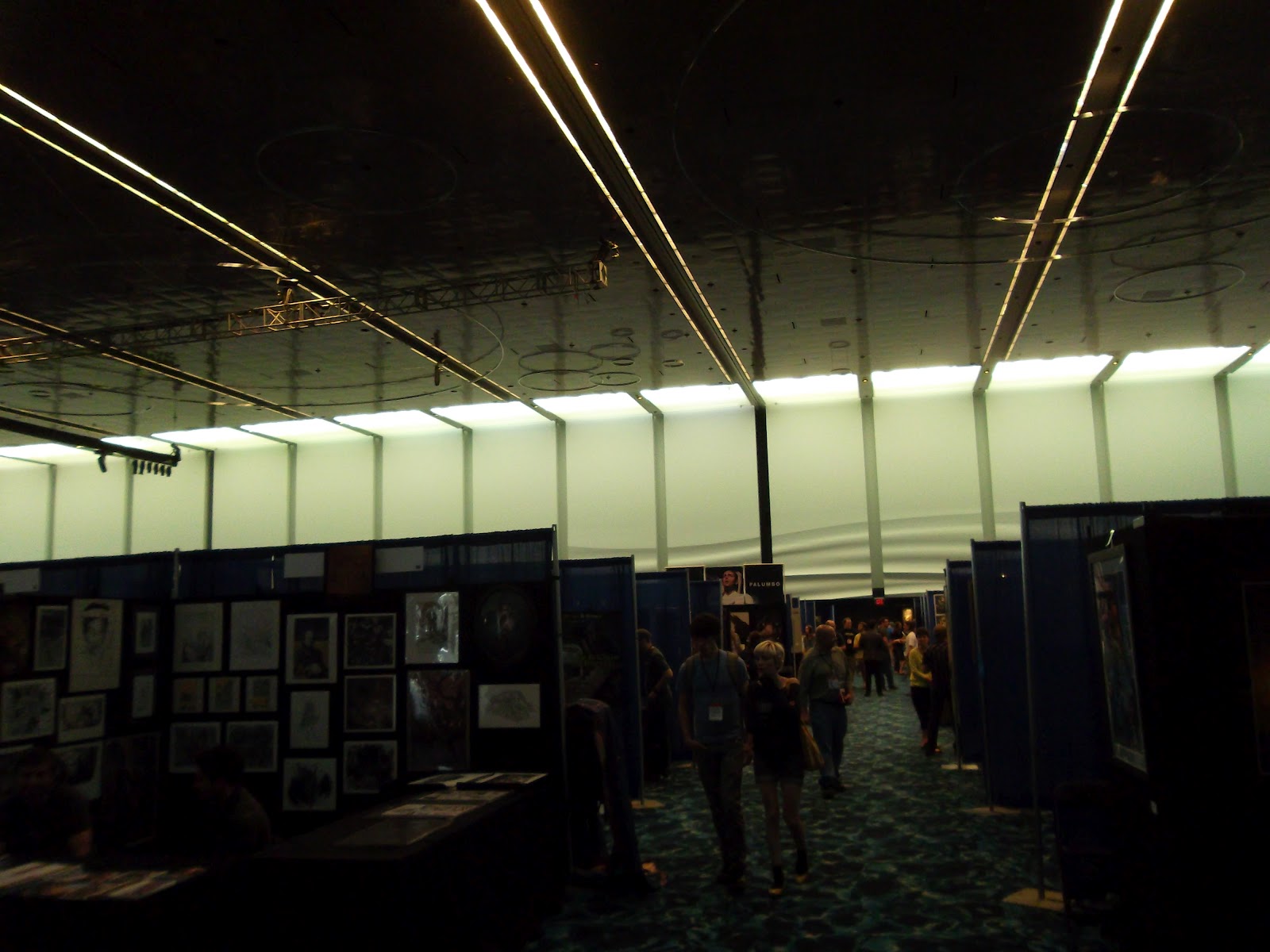
Rows and rows of awesome artists and art

 Some good take-aways we learned:
-It's painful and scary to be beginners.  However, what option did we have?  Pack up and quit and go home?  Nay, you just gotta do the best with what you have.  Everyone has to start somewhere.

-From Mike Mignola: If you never put out that dream project, you'll never have the chance for movie rights and other "big time" offers.  Expect to make no money and do it for the love of it, and who knows where it will go.  At least you've put it out on paper and sent it out into the world.

-When you're just starting out in fantasy illustration, 5-6 amazing pieces is all you need in your portfolio.  Take out all the filler, emphasize the "amazing" part.  Also, tailor it specifically to the company you are submitting it to.  Your portfolio for Magic:the Gathering is much different than your portfolio for book cover illustrations, which is much different that the portfolio you submit for editorial work.  

-from basically every presenter: DO WHAT YOU LOVE

-From Donato Giancola: Expect to make absolutely no sales from any craft fair/exhibition/expo, and just go for the love of it.  Think of it as investing in your career.  You'll always leave happy.

-We figured out that we have to step up our own game - we're working on designs for new display units as we type!

-Established artists are sometimes insecure and freaked out as well!  We've overheard numerous other exhibitors freaking out over who they're vending with as well.  One artist on a panel (who freelances full-time for Wizards of the Coast + others) said "I still feel like someone is going to reveal me as a fraud."  Sound familiar?
Overall we had a great time, got to (re)meet some other Bay Area illustrators and meet some of our heroes.  We have no regrets and are super thankful we were able to take the plunge and make it out to a whole new venue and a whole new level!

Award Ceremony honoring artists who won the Spectrum Silver and Gold Award
James Gurney receiving the Grand Master: an artist who has had at least 20 years in the art industry, who inspires others, and has made an impact in the community. He is Seal's hero.
Onwards! Towards more adventures!


Wednesday, May 16, 2012

Fear or Love? Your Choice


"If you try and give it your best shot, then the possibility isn't zero"

This weekend, Monkey and Seal will be on a plane towards Kansas City, Missouri for Spectrum Fantastic Art Live. We'll be vending next to some of our long-time art heroes. It's quite scary to be honest. We have never been to Kansas City. This will be our first out-of-state show. Most of the artists we'll be vending next to have at least 10-50 years of professional experience and have been published worldwide. Some of them have been doing art long before we were even born.They made the art that we looked up to as children. For Monkey, there is an artist that he has been following since he was 11 years old. We have also submitted multiple annual competitions for Spectrum, the magazine that is hosting the event, but have yet to break in and secure a published page. So going in there, we're pretty much unheard of. We are babies.

When we signed up, we didn't know what we were getting ourselves into. We thought it was going to showcase more different levels of experience, but everyone so far seems to be well established professionals. So in the last couple of days, as reality creeps on us, there is an overwhelming impulse to run away. To say, we're not ready for this. Maybe next time.

But we have this sign that we made, posted in our humble apartment when we first moved in about six years ago, "What would you do if you weren't afraid?"

So we asked ourselves, what is the worse that can happen? We don't sell a damn thing and don't make our flight money/hotel//booth back, but we can meet our heroes, geek out over artwork and life-changing workshops. Go or not go, which choice can we live with later with no regrets?

I think everyday, there is an opportunity to say yes to either fear or love. Fear of failure. Fear of embarrassment. Fear of the unknown. Fear that the journey is long and your skill level is not where you'd like it to be. We can choose those things. But we can also choose love. Love of art. Love of accomplishment. Love of pursuing something rewarding. Love of your work to have pride for it regardless of what people think of it. Love of people, artists. To recognize and acknowledge each other as unique creators. Love of the mysterious unknown. Love of the awkward growing pains. Love of yourself and how far you have personally come from.

In life we are always either running away or running towards our dreams. Why not choose the path that promises a brighter ending? After all, if you try and give it your best shot, then the possibility isn't zero. You're opening a window. You can make "impossible things, " possible, if you take a step forward.

So what can you do today to make that step towards your dream?  What are you scared of that you can embrace?  What path will you choose today that will promise a brighter future?  Grab hold, and let's take a step forward together.


Wednesday, May 2, 2012

You Can Change Your Dreams

And that's vegan, gluten-free mushroom pizza, if you were wondering.

Here at Monkey + Seal, we're all about chasing dreams - more specifically, we want to inspire you to chase YOUR dreams.

But sometimes, as we're working towards that dream, you might feel uneasy.  Maybe it wasn't what you expected.  Maybe you've heard a bunch of negative things from people you respect and trust.  Maybe you've found a different passion.  Do you give up on that dream, or do you keep plugging away?

This is something that unfortunately, (just like most big answers in life), there is no simple solution.  We can't just tell you what to do, because every situation is going to be different for every person at different points in their lives.  However, let's talk it through.

First off, why are you experiencing this resistance to chasing your dream?  Is it the hard work?  Because if it is, know right now that most dreams are going to take a good amount of effort.  They don't have to, but if you want to be excellent at something, it's going to take your 10,000 hours.  So if you want to jump board just because "it's hard," while we get it, and we empathize, it's no reason to abandon your dream.

If you give up because of your natural inclination to go with what is easy and avoid the hard work, then the unfortunate reality is that you're very unlikely to reach any of your dreams.  No matter what it is, putting in the work (let us emphasize that the work doesn't HAVE to be hard, there is just usually a lot of it), is a necessary component for any dream.  If you give up now, you'll find another dream, and then you'll be more likely to give that dream up because of the work involved.

So what happens if it's not the work but something larger and more fundamental?  What about when you achieve your dream, and you find out that your dream has changed?  Maybe you're older and want something else, or maybe your life's priorities have changed.  That's okay too.  It's a natural part of growing.  Maybe you've realized that that dream company with all the status isn't really the best place for you. Perhaps you woke up one day realizing that it was your mentor's dream, or your parent's dream, or what you thought you wanted based on what you assumed a rational human being would want.  Maybe it is what you imagined that your ideal self would want.  A good example of this case is if you think you should want to be self-employed because tons of people (Monkey included) extoll the virtues and freedom and all the benefits of being self-employed, when you really want stability and security and to not have to worry about all the challenges self-employment might bring (legal status, taxes, permits, finding customers, etc. etc. etc.)  Perhaps maybe you're just bored now that you've finally gotten what you've always been working towards.

Regardless, we want you to know that IT IS OKAY.  Whether you've invested four hours or fourteen years, it's totally okay that your dream has changed.  It may feel at first like you've lost a lot of time, or that you wish that you discovered that it wasn't your dream earlier.  However, you probably wouldn't have ever even known that your dream wasn't right until you achieved it, and you wouldn't have wanted to live you life with a huge "What if" hanging around in the back of your mind.

Also, think about all the new things you've learned on your journey.  You've completed a journey, which is a huge accomplishment in itself, and you've probably learned about your new passion and goals from achieving your first (or second, or third, etc.) set.  Feel free to take some time to reflect on your path to where you are now, and give thanks for all the challenges you've learned from, the good and great stuff that's come out of your hard work, and all the people you've met and who have helped you get to where you are.

You might be frightened because you're starting over.  After all, to quote Linkin Park, "the hardest part of ending is starting again."  You're might be switching fields completely, going from being an expert to being a beginner again, or you could be just shifting over, utilizing a slightly different skill set than what you were doing prior.  Whatever it is, don't fret.  Change is good.  It keeps things interesting and it's okay to be a beginner again.

Remember: if you learned anything at all, (even "I hate this"), then it wasn't a waste of time.  Wrap  up what you have to, and start preparing for the next major journey in your life.