Wednesday, July 11, 2012

Get a hobby, that’s not art!

  
One day, I woke up and I didn’t want to do art anymore. I thought it was boring. I wanted to read, to see the world, do crossword puzzles, laundry - anything but art. Though I love it and give it everything I’ve got. That was exactly the problem.

Here at Monkey and Seal, we are always encouraging you to follow your art. To cultivate it. To dream it. To pursue it wholeheartedly with focus and intention. Now we encourage you to get a hobby that’s not art.

To put art in a special jar. Water it. Now, go do something else.

The funny thing about art is that it stagnates when you look at it too much, but grows faster when you are simply enjoying life fully. That means, going to the movies, seeing friends for coffee, or trying something new like belly dancing.

If you lock yourself up in your room, studio, or office to create art for long periods of time, it’s pretty much the same thing as a work prison for your inner artist. You can be inside one of the most spectacular hotel suite, or dream studio, but if you don’t have anything else besides art and art is your only goal, you’re still going to feel like a caged bird performing tricks doing the expected routines. Stare at the same four corners every day and you’ll find yourself quickly drained of new ideas. 

When art becomes the sole focus of attention, then art becomes very “serious.” And when we become “serious,” we become very uptight, solemn, and predictable. BUT hobbies, take the “seriousness” out of your art-making process, and introduces playtime.  

Yes, there is more to life than art. GASP. And by exploring other aspects of your life and interest aside from your main art, you’ll be greatly rewarded by creativity. By doing other things you'll expose yourself to new inspiration, outlook, and experience. With art, you can’t predict when an inspiration strikes.

So walk about. Take up biking, container gardening, fencing, or whatever hobby suits you.

Our brain is wired to process new information. While you are taking a “break” from art, your brain is furiously making connections with your new activities. Your next sculpture idea can come from the anatomy of a flower. The next film idea from the latest crime investigation news or the local mysterious Laundromat. The next crochet pattern idea comes from the sushi bar where you and your friends last ate.

Other than being an artist, what 5 other hobbies and lives can you have?

For Seal, she is a crime investigator journalist, a dancer, martial artist, a chef, and an architect. One of her hobbies is actually to investigate a crime through multiple news reports and spot inconsistencies. She is an arm-chair detective and her interest in journalism brings up many novel ideas for a film she’s working on. When she’s stumped on her painting, she also likes to do yoga or go for a run in the neighborhood. She has made friends with some of the local cats and she always stops by the row of stargazing lilies growing on Presidio and Broadway St. These activities actually help her to focus on her art when she’s back in the studio, and bring fresh takes to an otherwise repetitive art-making patterns.

Hobbies allow art to always become new adventures. Instead of a dreary day of art making. Art becomes a wink and a smile before and after work. With stolen glances in the middle of a busy street. A surprise visit during lunchtime. An afternoon nap. In bed with cinnamon hot cocoa. When art is balanced between attention, care, and immersion, with playfulness, distractions, and leisure, every time you return to the canvas, it will be refreshing.

So, what 5 other hobbies and lives can you have?

Wednesday, July 4, 2012

Put Off Your Project To Get Off Your Ass


While some of you out there may be struggling to get inspired to create, there are some artists out there who struggle with an overflow of ideas.  While at first glance, this might seem like an awesome thing, but it can be paralyzing to have hundreds of different ideas in your head that you want to express, yet you don't know where to start.

Maybe you have a story for a graphic novel or three, as well as some character designs you'd like to do, and an idea for a film, and a photography project you'd like, as well as some t-shirt designs and ideas for your wedding invitation design, etc. etc. etc.  The list goes on, and you maybe are just overflowing with stuff you want to do, but there's never enough time to do all of it (especially if you're also doing a day job, juggling obligations to friends and family, and you know, living life.)

If you don't suffer from this dilemma, one might not understand how potentially crippling this is.  You might say "Yeah, but at least you got ideas," but the truth is it is sort of like being given your choice of being able to eat one single dish of anything you'd like in the world.  You start thinking "I really like this..but what about..this?"  You don't want to waste this awesome opportunity, so you start weighing your options.  You really want the seared swordfish with the mango salsa, but then you've never tried the sauteed water spinach with 17 different herbs and marinated tofu.  But you don't even know if you like tofu or if you'll get sick of it, because there's also that weird thing that you've never eaten because it's $200 a pound, but what if you don't like it...you know nothing about it, so you start to google everything, and then it becomes one big massive information overload and the clock is ticking and you're not even eating anything but you're starting to salivate thinking about all this awesome food and it sucks that you only get to choose one thing, but what do you choose since everything looks so good and while you might want something familiar are you really going to blow this chance to try ANYTHING over a simple bowl of mac and cheese?

Yep, that's sort of what idea-overload is like.

If you do suffer from idea-overload, you'll probably be familiar with the overwhelming sense of confusion over what to do right now.  Sure, you know that you want to do all of these things, but where do you start?  It's so daunting to have five bazillion long-term projects that you want to do.  What project do you prioritize?  You don't want to lose steam or forget an idea, what do you do?

The answer is simple, friends, what you need to do is put it off.  Whaa?  Yes, well, sort of.  The first thing you need to do is voice memo, or write, or somehow record all of your ideas and projects, however you work best. Just make sure it's someplace you can find later.  Monkey personally likes sketchbooks and google docs, but that's just him (he also makes it a point to revisit old sketchbooks every 6 months or so to find old inspiration).  So get all the ideas down out of your head.

Now, go take a break.  Walk around the block, or meditate, or watch some crap TV, or read some fiction, or otherwise take your mind off creating something.  Focus on something else.  Now, revisit your list, looking at everything at once, and whatever project tugs at your heartstrings the most, do that one, and put all your other projects away.  If you need to be more analytical about this, prior to the break you can make charts and pros and cons and how-long-will-this-take evaluations and comparisons, and all of that stuff, but I say go with your gut in this case.

Know that you'll have more time later to devote to your other projects, but not only will you be able to start, but you'll also be able to handle the project that you want to do most.  This is important, as if you try to do a little work on everything at once, you'll easily get bogged down with the lack of momentum on any one project, and you'll end up not getting anything done.  Multitasking is a myth, as we've talked about before, and every time you switch gears, you lose momentum.

At Spectrum Live, concept art hero Ian McCaig talked about how he's been working on a story for 25 years(!).  He knows the importance of working when the time is right, and not forcing a project when it's not ready.  This is the other benefit of choosing what to work on from a pure-inside-your-heart way of thinking.  Forcing your creativity when you're working on a commercial project is one thing, but if you're doing something for yourself, then really go with your internal flow and don't rush things.  Feel free to put things down and restart them.

So put off the huge bunch of stuff, and deal with one (or two) things at a time, but realize that you can always stop and start something else up.  The point is to not do that too frequently, and to not rush yourself to work on a project that isn't ready.  So let your projects simmer if they need to, and that'll get you off and going.  

Wednesday, June 27, 2012

How to Fix the Problem of Style


Whenever you hear artists talking about "breaking into the biz," the topic of style will undoubtably come up.  We guarantee that at least one person will ask the question "Do I need a style?" or "How do I find my style?"

We can answer that very simply right off the bat:  "Yes, if you want a job," and "Lots of art.  Lots and lots of art."

The first part is pretty reasonable: art directors/gallery curators/talent scouts/literary agents/etc. need you to have a style.  You might wince at this truth, but believe us, it's true.  As a hiring manager, the art director is going to look for someone that is safe, reliable, and they believe they can trust.  For an art director hiring you as a freelance artist, they are literally gambling their career on you.  If you mess up a book cover that delays production, besides you getting fired, the art director's job could be on the line as well.  So it's safe to say that yes, you do need a style as the person hiring you is looking for something reliable, and a style is your reliable method of expressing yourself.

The second part can be depressing or comforting all at the same time.  It can be a major bummer, as there is unfortunately no shortcut to finding a style besides making tons and tons of art.  It's comforting in the way that it is something that will come, and you can only speed up by working really really hard.
Simple as that.

So we've all agreed that you do need a style.  Well, what if you have multiple styles?  What if you like to work in metal sculpture, but you also do spoken word?  Or what if you love to paint detailed landscapes in watercolor but also love huge abstract oils?  What if you're a modern dancer and a short story writer?  How can your fellow artists ask that you choose between your true loves?

Or how about the fact that you like changing your style up from month to month.  Maybe you like photorealism, then you like loose brush pen work.  Maybe switching from well-composed photos in black and white to wild experimentations with exposure and light.  How can you ever hope to just stick to one single thing?

Well, if you know us at all, you'll know that we're big on experimentation, and not big on binary thinking.  The secret to fixing the issue of choosing a style and sticking with it is knowing that you don't have to.  

Yes, you heard us right, you don't have to stick to a certain style.  Please keep reading before you run off and send your art director your new experiment in style, however.  

So while you don't have to stick with a single style all your life, or even all month, it is important that you develop a body of work that has a consistent style.  You want to show curators or art directors or whomever might be asking for your work that you can consistently (key word here) produce the same style of work.  

What you can do, however, is create side projects.  If you find multiple, very different styles that you're constantly switching between, we recommend making an entirely different artist persona.  While Monkey (ie Rick Kitagawa) is known for dark, creepy, scary paintings, his other artist persona creates wildly light-hearted, funny paintings.  By separating the two styles into two distinct artists, Monkey has allowed himself the freedom to constantly work in both styles, but also maintains the commercial appeal of having a consistent style that people can count on him for.  

If you don't want to go as far as to create a whole new alias, you can always just create little sub-portfolios.  You show the art director for the game company your game asset portfolio, and you show your giant abstract pieces to your interior decorator collectors, and you show your giant paintings of purple elephants to your group of collectors who are into that sort of thing.  The main thing is that you don't want the video game art director to think that you're only going to give them purple elephants - you want that person to think you're going to give them awesome game assets.  

So, while it is the harsh reality that if you want to make money, you will need a consistent style at some point, think of it like a project identity, less of like a ball and chain that will hamper your creativity.  


Wednesday, June 20, 2012

Real Artists Experiment


Often times, when you're looking at the work of any "big name" commercial artist, you'll see a very distinct style.  Sometimes it'll change a bit from solo show to solo show for any given artist, but most likely what you see on their blog and in their portfolio is a very cohesive body of work.

This often leads us to believe that these people don't experiment.  We think that maybe these artists "have found their style" and don't deviate much from it and just keep making paintings all in the same style over and over again.

However, part of this is the game they have to play as commercial artists.  As a high-profile artist, often times there is a lot of pressure to stick to a certain style as galleries are businesses, first and foremost, and if the artist got big doing a certain style, they're going to want what is already proven to sell.  Often times the artist will recognize this and continue to make art in that style to appease the gallery and their fans, as this is what allows them to live off their art.

That said, we only usually get to see what they do in the public sphere.  Just because we see our favorite artists doing the same thing over and over again doesn't mean that they aren't trying out new mediums, or new styles, or new subject matter.  We just don't get to see it.

So go out there and experiment.  Try something new.  If you paint, what about some sculpture?  If you do installations, what about some pen and ink drawings?  Create photo-realistic stuff, try some doodling.  Manga artists, how about some landscape paintings?  However outside of your comfort zone you're willing to go, we say "Go there!"  

Just as the public doesn't get to see a lot of artists' experimental work, the public doesn't necessarily need to see YOUR experimental work.  Under no obligation must you post it on a blog, or put a photo on Facebook, or do you need to show another living person if you don't want to.  Go crazy, and if you hate it, dump it, burn it, whatever.  The main thing is that by pushing yourself to go someplace that you haven't gone before, it'll change the way you look at what you "normally" do.  You might gain some new insight, or you might even find something you really enjoy (maybe even more than what you usually do).   This experimentation, while it may be your "new style" in the end, is really for you and your artistic soul more than for anything else, so try something new when you get the chance.


Wednesday, June 6, 2012

How to Save Yourself From Burn Out


When I arrived Saturday morning for my weekend painting workshop, I was tired from the week's work - month's work, to be precise. I had taken on one too many calls, one too many emails, one too many art-donation charity events, one too many project, and not taking good care of myself. I was "burnt-out." This is the dark side of the artist life.

When we are depleted of time and energy, so it our creativity and art. We become a snarling animal prodded one too many times and we refuse to perform any more magic acts. Having experienced burnt out before, I thought I knew how to avoid it. I thought I knew better. But it's difficult. The fine line between a fun creative productive artist and a manic overworked "horse" is very thin. Although sometimes there doesn't seem to be much of choice between work/rent vs sustainability/rest, we have to remember - there is always always a choice.

Contrary to the myth that artists are selfish, I think we are very generous - perhaps even too much. We are often taking on projects that are not ours. We make posters for Uncle Steve's bbqs or little Billy's birthday party for no cost. We often volunteer in some creative or mentoring program for the community. People often use artists as a sounding board for idea pitches, solicit critiques, or even rants on personal lives without refilling our energy wells. We, ourselves, often dip into our own well and drain it faster than we can refill it. We say "yes" to the latest social gathering when we really want to be alone with our art. Or quite the opposite, we stay home, when we really want to go dancing but are afraid. In short, we are NICE PEOPLE, but not necessarily honest to ourselves.

But what if I have kids or are in a relationship or have friends who need me? You ask. Surely, they come first before my art? The truth is: we can become better family members and friends when we take care of ourselves and our needs first. When you give to yourself, your energy and time will surprisingly multiply by ten fold.

It's time to think a little bit more of ourselves. It's time to be more selfish. Take care of your artist self. Invest in yourself. "Stop being nice, and start being honest," as writer Julia Cameron said. So you don't want to do this project, DON'T DO IT. Give it to someone else who has the time and is more passionate about it. So you need to stay in instead of a movie date? Take a raincheck. But what about timed events that you have to attend, but may not have energy for, like gallery openings, friend's poetry reading, or billy's birthday party that might make or break your friendship or relationship? Well, take care of yourself days ahead and the morning beforehand, so you have plenty of rest. Wake up earlier in the week before work, or sleep in, or find the time and prioritize your creativity so that at Billy's birthday party or your friend's poetry reading, you are alert, attentive, and present - NOT thinking about your novel or project back home and seething at Billy in resentment.

Self care and freedom is the best remedy for burn out. A little goes a long way. Like buying your favorite soap for $2.99 or warm hot cocoa. Finally watching that movie or reading that book that you've been putting off. Calling a friend who can help you refill the well by listening to you. Freedom from email or phone after dinner. Freedom to rest. Freedom to see friends or go on a run. Undisturbed guilt-free time. It's going to be different for everyone.

At the weekend painting workshop, my teacher Erik Tiemens always seemed very energetic, creative, and animated.

"Attack the paper," he would say.

"Play with the paint, without having an end-product in mind." I don't know if this is true, but I suspect that he will always be young-at-heart and creative because he gives himself the freedom to play.

Our artist self is like a seven year old kid. If we told it to sit still, be quiet, and do your work for one too many times, it will start to rebel. So we need to communicate to them that we'll listen to them. That we will give them a treat for being so good all this time. That we are on their side and it's safe to create again.

Just ask yourself, what do I want? If there are no emergencies, no restrictions, deadlines, or people depending on me and I have the freedom to do whatever, what do I want?


Wednesday, May 30, 2012

The Balance Between Business and Art

Monkey reads a lot of marketing and business blogs, courses, and books.  He makes sure he has a strong grasp on the business side of Monkey + Seal, as he handles a majority of those aspects.  However, while educating yourself about the business side of art is helpful and necessary for most, many artists have trouble managing the balance between the business development side of art, and the actual creating.

When Seal is working on a freelance project, she usually hits a 70% creating - 30% business, which is super awesome.  Monkey, on the other hand, is lucky to hit 50-50.  So how do you manage your own creation-business balance and what is the ideal?


While if you're already familiar with the business side: marketing, budgeting, pricing, distribution, accounting, and maybe stuff like web designing or printing, you may struggle to find more time to devote to your creating.  However, if you're already making art like a fiend but have no idea how to do any of that business stuff, perhaps you need to spend more time developing your business skills.

So what's the ideal ratio?  Well, it all depends on you.  Personally, a good balance with a stronger emphasis on the creating is what we recommend.  For us, we'd rather be at 90-100% creating, and doing very little business stuff (maybe we should hire an agent or assistant), but there are definitely people out there who really enjoy some of the business part, so you should lean more towards the business side.

The reality of it is that an ideal is probably about 70-30 creating-business.  Seal has found that works well for her, and Monkey agrees.  Monkey has been struggling with this personally for some time, usually spending closer to 80% of his time on business, sadly skimping on the creating.

If you make this same mistake, what happens is that while you may be great at drawing an audience and making sales, what you soon find out is that you run out of stuff to promote or develop.  Monkey lost focus on what was really important (making art), and focused too much on the "gotta make money" side of things.  He recently shifted more towards 50% creating (a big swing for him), and he found that by doing more of what he loves (creating), the money (the business) is following.

So we encourage you to spend more time doing what you love and less time doing what you don't like to do.  While learning the basics of marketing and selling art is important if you want to make a living off of it, make sure that you don't forget what your main purpose is: creation.  Do more of what you love, and the money will follow.  

Wednesday, May 23, 2012

Thousands of Dollars Worth of Lessons From Spectrum Fantastic Arts Live!


This past weekend Monkey + Seal took the long trip over to Kansas City for Spectrum Fantastic Art Live!  It was three days of being surrounded by some of the most amazing contemporary fantasy artists out there. 

The week prior was sort of a whirlwind of madness.  Seal had concept art, storyboard, and commission work to do.  Monkey had an event he was coordinating on Wednesday, then hung the latest Big Umbrella Studios show on Thursday for the opening on Friday, and he painted all weekend.  Then, it was a mad dash Monday through Wednesday to finalize transportation plans, get prints made, figure out new displays, and pack. 

Monkey ordered plastic sleeves that didn't come in on time, we didn't sleep from 1:30pm on Wednesday until we got on our plane at 2:30pm on Thursday.  There were no restaurants open by the time we rolled into our hotel at 1am Friday morning, and so we had a large amount of pretzels, snack crackers, and dried fruit for dinner.

When we arrived at the convention center the next day, Monkey started freaking out due to the sheer overwhelming amount of "big name" artists with huge original paintings and giant, framed canvas prints.  However, Seal's courage was strong enough for the both of us and as Monkey calmed down, we started to set our booth up.


Over the next three days, we got to meet some amazing artists, listen to great presentations, and we even managed to sell some merchandise.  Even though the crowd was much smaller than we had hoped, we learned a lot and came out smiling.

To be honest, it was an expensive bunch of lessons and tips (even trying to take all the budget options) we ended up investing thousands of dollars that weren't made back.  This was a bit hard to take in, but the lessons were invaluable and viewing this as an investment in our careers rather than losing money has helped ease the sticker shock considerably.
 
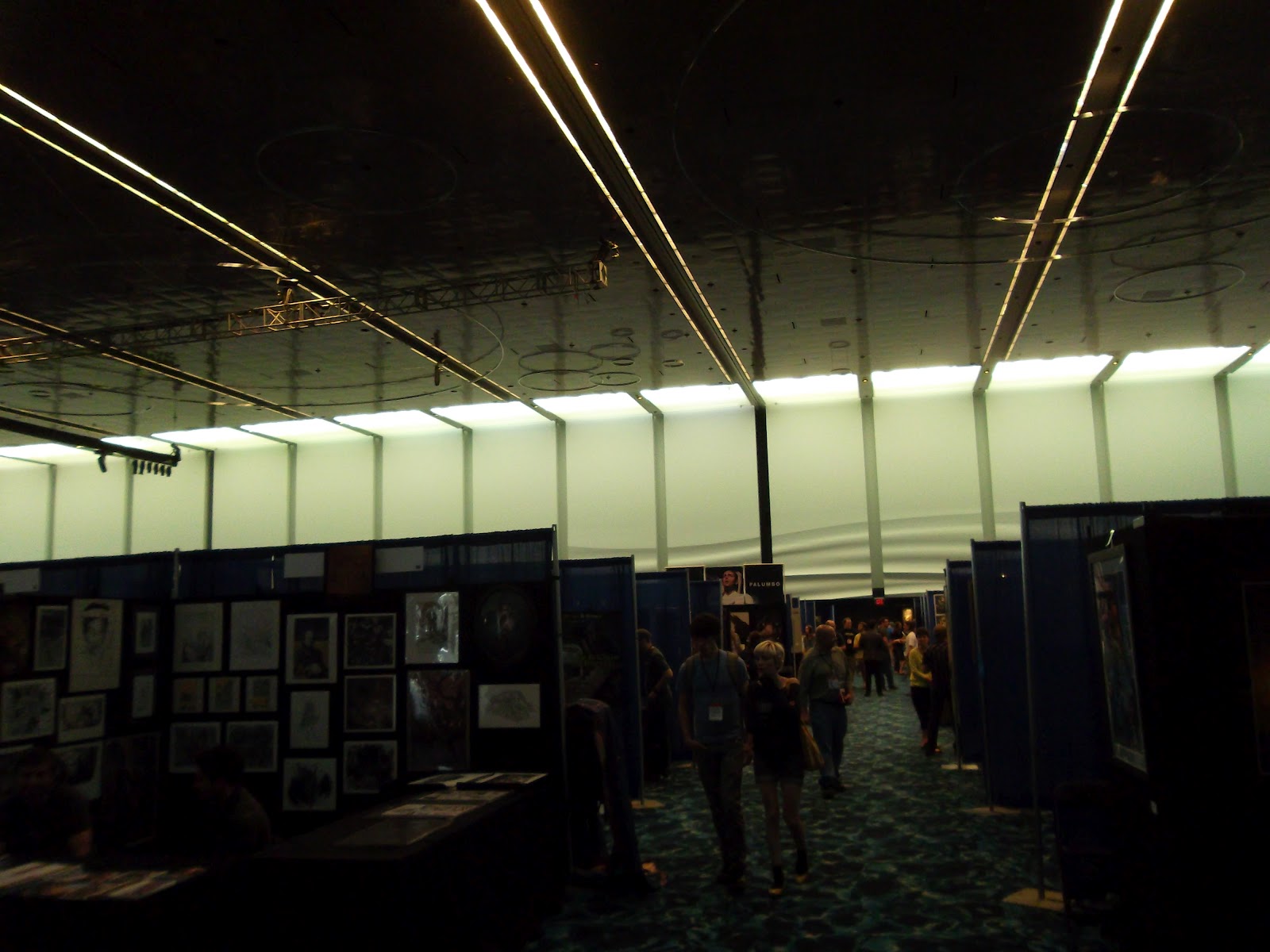
Rows and rows of awesome artists and art

 Some good take-aways we learned:
-It's painful and scary to be beginners.  However, what option did we have?  Pack up and quit and go home?  Nay, you just gotta do the best with what you have.  Everyone has to start somewhere.

-From Mike Mignola: If you never put out that dream project, you'll never have the chance for movie rights and other "big time" offers.  Expect to make no money and do it for the love of it, and who knows where it will go.  At least you've put it out on paper and sent it out into the world.

-When you're just starting out in fantasy illustration, 5-6 amazing pieces is all you need in your portfolio.  Take out all the filler, emphasize the "amazing" part.  Also, tailor it specifically to the company you are submitting it to.  Your portfolio for Magic:the Gathering is much different than your portfolio for book cover illustrations, which is much different that the portfolio you submit for editorial work.  

-from basically every presenter: DO WHAT YOU LOVE

-From Donato Giancola: Expect to make absolutely no sales from any craft fair/exhibition/expo, and just go for the love of it.  Think of it as investing in your career.  You'll always leave happy.

-We figured out that we have to step up our own game - we're working on designs for new display units as we type!

-Established artists are sometimes insecure and freaked out as well!  We've overheard numerous other exhibitors freaking out over who they're vending with as well.  One artist on a panel (who freelances full-time for Wizards of the Coast + others) said "I still feel like someone is going to reveal me as a fraud."  Sound familiar?
Overall we had a great time, got to (re)meet some other Bay Area illustrators and meet some of our heroes.  We have no regrets and are super thankful we were able to take the plunge and make it out to a whole new venue and a whole new level!

Award Ceremony honoring artists who won the Spectrum Silver and Gold Award
James Gurney receiving the Grand Master: an artist who has had at least 20 years in the art industry, who inspires others, and has made an impact in the community. He is Seal's hero.
Onwards! Towards more adventures!